Single-Shaft vs Double-Shaft Shredder: Which One Should You Choose?
Single-shaft and double-shaft shredders are both used for primary size reduction, but they solve different feeding and cutting problems. Choosing between them should start with the waste itself: its dimensions, wall thickness, bulk density, toughness, whether it is loose or baled, how uniform the discharge needs to be, and what equipment comes next.
The short answer
For many plastic recycling lines, a single-shaft shredder is preferred when the material must be fed in a controlled way and the discharge size should stay within a defined range. A double-shaft shredder is more suitable when the first priority is strong grabbing, tearing and bulk reduction of very large, irregular or difficult waste. Neither design is automatically ‘stronger’ or ‘better’; the correct choice depends on the job the shredder must perform.
Contents
- 01The simplest way to understand the difference
- 02How a single-shaft shredder works
- 03How a double-shaft shredder works
- 04Which materials are better suited to each design?
- 05Why single-shaft shredders are common in plastic recycling lines
- 06When a double-shaft shredder has the advantage
- 07Screen-controlled output vs rough primary shredding
- 08Film and woven bags: why feeding control matters
- 09Pallets, bins and large rigid products
- 10Metal contamination changes the recommendation
- 11Do not choose by motor power alone
- 12When should a shredder be followed by a crusher?
- 13What information should you provide before asking for a quotation?
- 14Final selection: match the shredder to the job
- Frequently asked questions
The simplest way to understand the difference
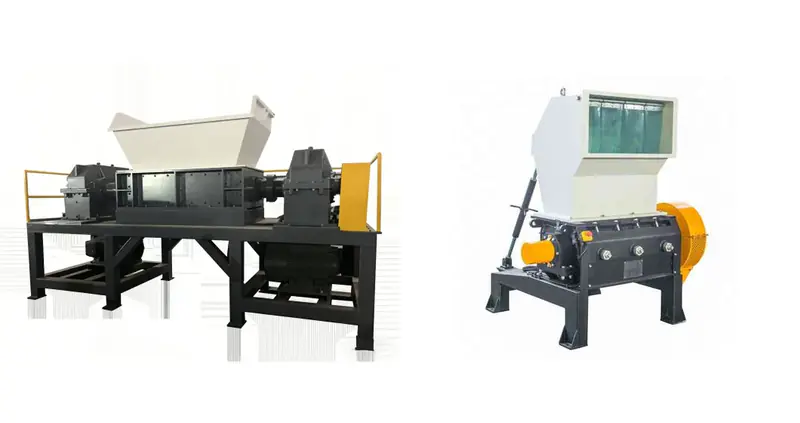
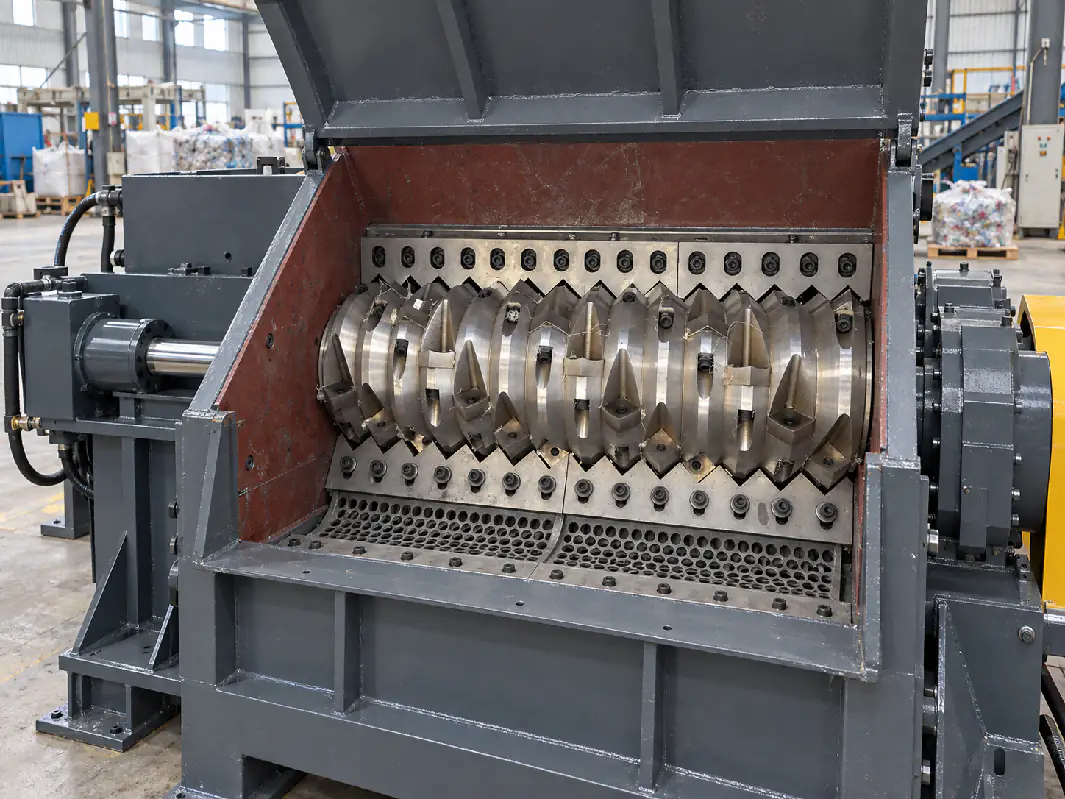
A single-shaft shredder uses one rotor and normally relies on a hydraulic pusher to press material against the rotor. The rotor carries replaceable knives, and a screen below the rotor controls the maximum discharge size. This combination gives the machine relatively stable feeding and a more controlled output.
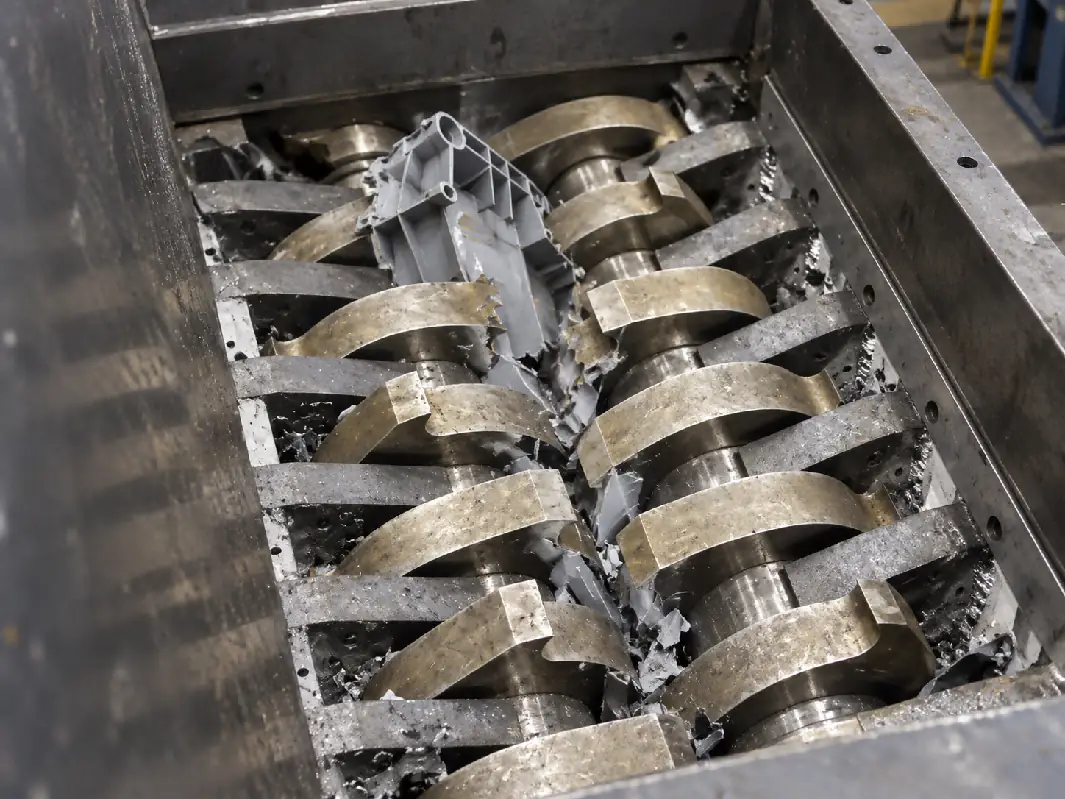
A double-shaft shredder uses two counter-rotating shafts fitted with intermeshing hooks or knives. The two shafts pull material inward and tear it apart between the cutters. Many double-shaft designs operate without a sizing screen, so the discharge is usually larger and less uniform, but the machine has very strong grabbing ability and can accept bulky or irregular products more easily.
Naming varies by market: a double-shaft shredder is also sold as a twin-shaft shredder, dual-shaft or two-shaft shredder. These names describe the same two-shaft design. Four-shaft shredders add a second pair of shafts for finer, more uniform output from one machine, but they are larger and more complex and are mainly used for mixed solid waste, e-waste and similar streams.
| Feature | Single-Shaft Shredder | Double-Shaft Shredder |
|---|---|---|
| Cutting principle | One rotor cuts against fixed counter knives | Two shafts tear and shear material between intermeshing cutters |
| Feeding control | Hydraulic pusher controls contact with the rotor | Two shafts pull material inward directly |
| Typical speed | Low-speed cutting with controlled feeding | Very low-speed, high-torque tearing |
| Screen | Commonly fitted under the rotor | Often no sizing screen in primary-shredding designs |
| Discharge size | More controlled and relatively uniform | Coarser and less uniform |
| Best use | Plastic recycling lines needing controlled pre-shredded size | Primary reduction of bulky, irregular or difficult waste |
| Common downstream step | Washing, crusher, compactor or extrusion | Crusher, sorting or further size reduction |
How a single-shaft shredder works
The feeding chamber of a single-shaft shredder is usually wide and open so that bulky plastic products, film bales, woven bags, lumps or production scrap can be loaded directly. A hydraulic pusher moves the material toward the rotor. When the rotor load becomes too high, the control system can pause or retract the pusher and then resume feeding. This prevents the machine from being continuously overloaded and helps stabilize throughput.
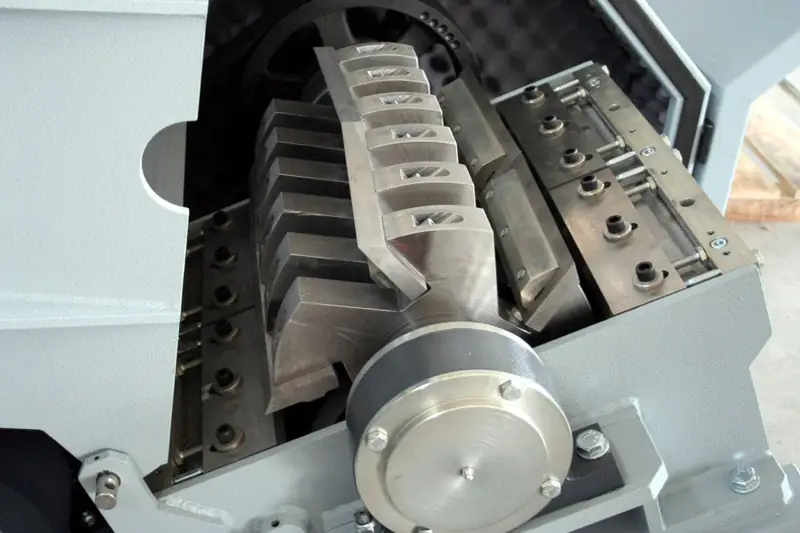
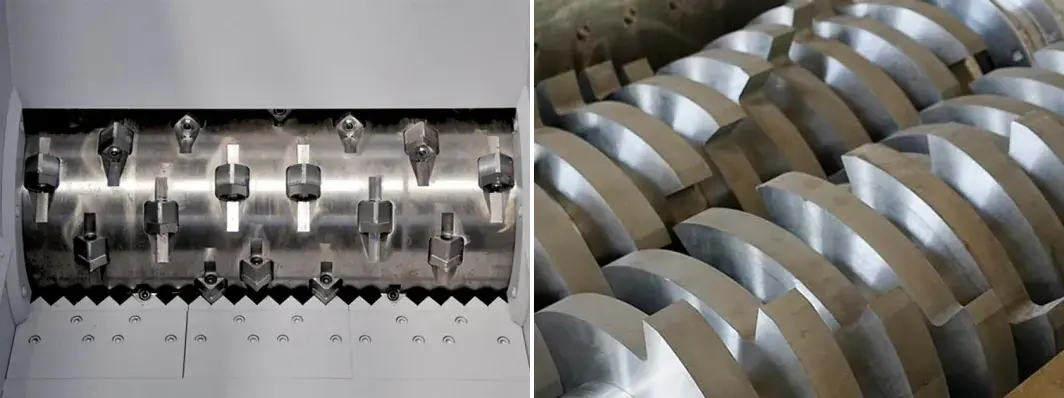
The rotor is equipped with replaceable square or profiled knives. As the rotor turns, the knives cut the material against fixed counter knives mounted in the chamber. After the pieces become small enough, they pass through the screen below the rotor. The screen opening therefore has a direct influence on output size, throughput and energy consumption.
This controlled feeding behavior is one of the main reasons single-shaft shredders are widely used in plastic recycling. The machine can repeatedly bring light, flexible or irregular material back into the cutting zone rather than relying only on gravity.
How a double-shaft shredder works
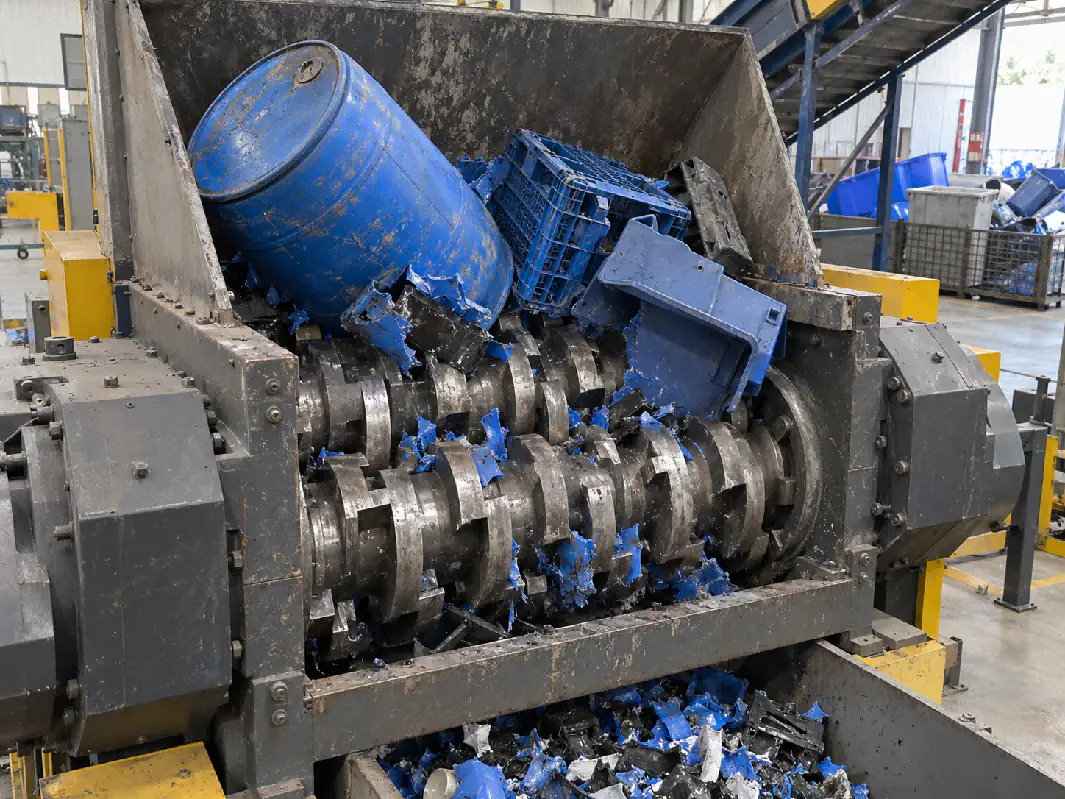
A double-shaft shredder has two parallel shafts rotating toward each other at low speed. Each shaft carries a series of thick cutters or hooks separated by spacers. As the shafts rotate, the hooks grab the waste, pull it downward and tear it apart. The material is reduced by a combination of shearing, tearing and squeezing.
Because both shafts actively grab the feed, a double-shaft shredder normally does not require the same hydraulic pusher system used on a single-shaft machine. This gives it strong self-feeding ability for bulky hollow products, irregular scrap and mixed items that are difficult to push consistently against one rotor.
The trade-off is output control. In many primary-shredding designs there is no screen directly below the shafts. Pieces leave the chamber once they have been torn small enough to fall through the cutting area, so particle size is determined mainly by cutter width, hook geometry and the number of cutter teeth. If a smaller and more uniform flake size is required, a crusher is usually installed downstream.
Which materials are better suited to each design?
The material form is more important than simply asking for a certain motor power. A 1,000 kg/h line processing loose film behaves very differently from a 1,000 kg/h line processing large plastic drums or heavy purge lumps.
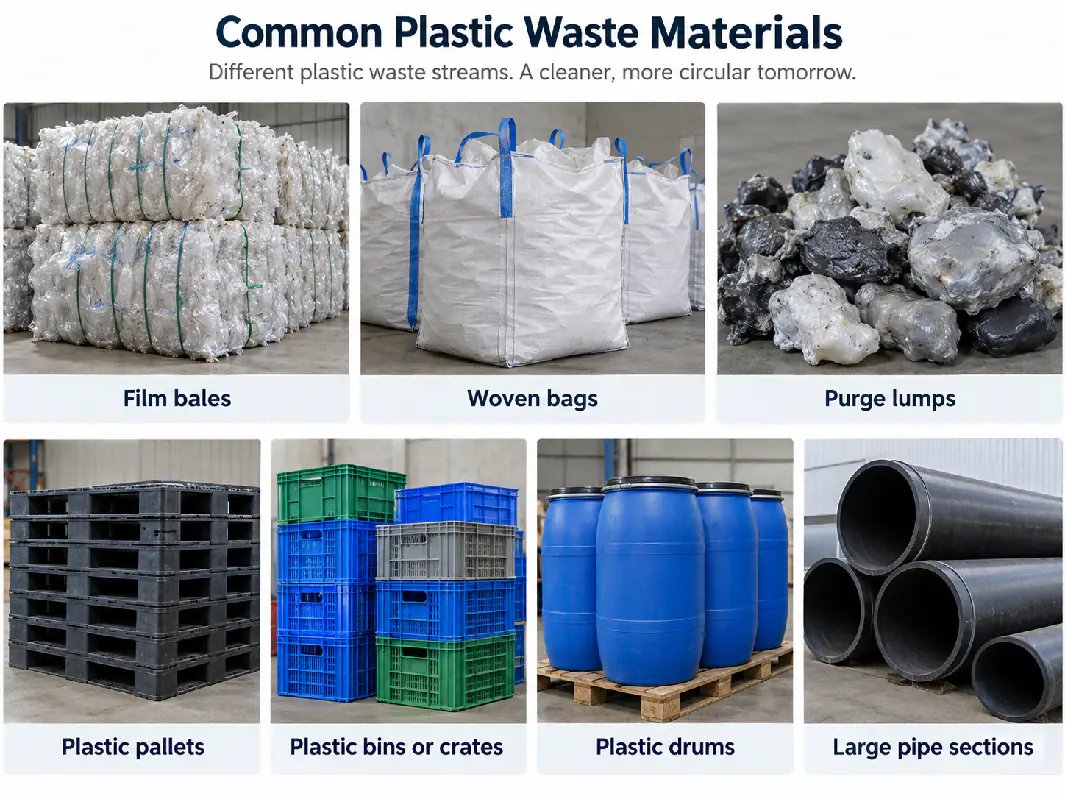
| Waste material | Typical choice | Why | Possible next step |
|---|---|---|---|
| LDPE/LLDPE film bales | Single-shaft | Hydraulic pushing helps control low-density, elastic material and reduces unstable feeding. | Washing or wet crusher |
| PP woven bags / raffia | Single-shaft | Controlled feeding is useful for loose or baled flexible material that tends to bridge or wrap. | Washing / crusher if needed |
| Plastic lumps / purge | Single-shaft | Screen-controlled discharge and high torque are useful for dense production scrap. | Crusher or extrusion |
| Plastic pallets | Single-shaft or double-shaft | Choice depends on pallet size, thickness, metal contamination and required output size. | Crusher if fine flakes are required |
| Large bins / crates | Single-shaft in many recycling lines | Hydraulic pushing gives stable feeding; screen helps prepare material for a downstream crusher. | Crusher |
| Large drums / hollow containers | Double-shaft for aggressive primary tearing; single-shaft also possible | Bulky hollow geometry can benefit from strong self-grabbing action. | Crusher / washing |
| Large-diameter pipe | Single-shaft / pipe shredder; double-shaft for rough primary reduction | Diameter and wall thickness determine the preferred feeding method. | Crusher if smaller output is needed |
| Mixed bulky plastic waste | Double-shaft | Strong grabbing and tearing are useful when shapes and sizes vary greatly. | Sorting / crusher |
Why single-shaft shredders are common in plastic recycling lines
In a plastic recycling plant, the shredder usually needs to do more than simply tear material apart. Its discharge must also be suitable for the next machine. This is where the single-shaft design has a clear advantage.
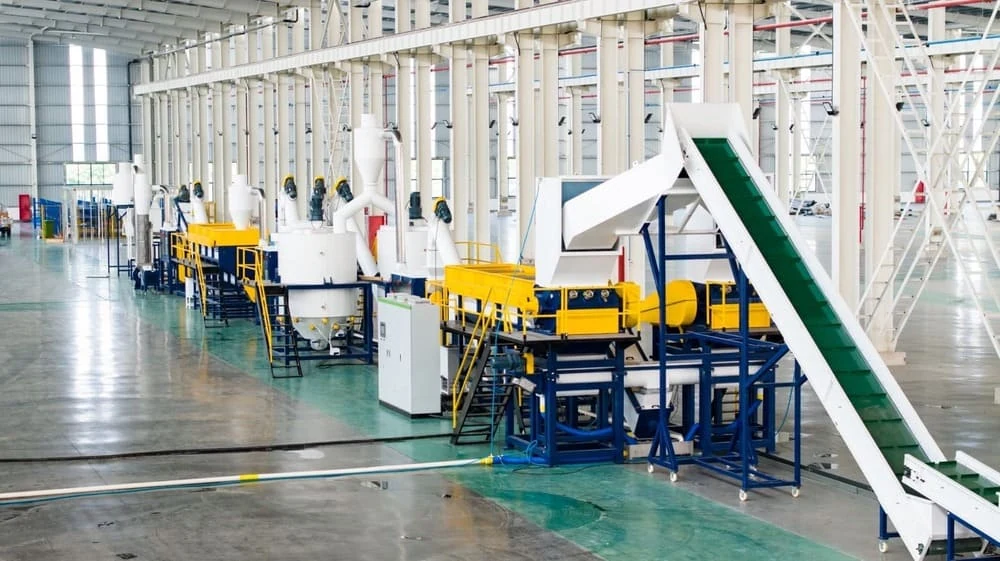
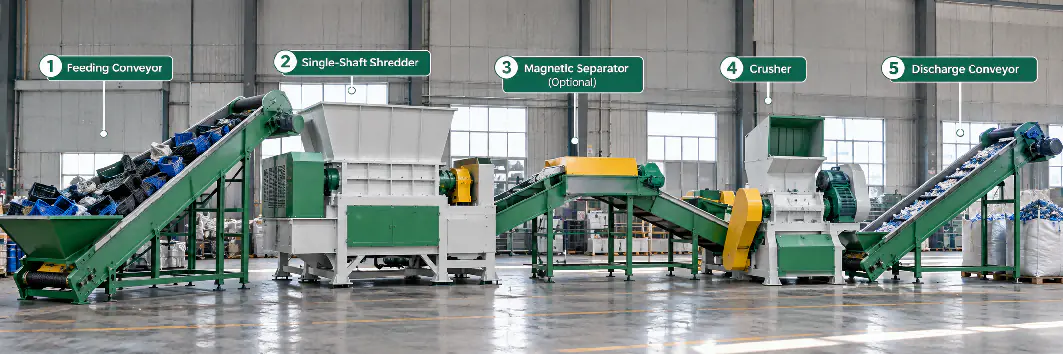
The screen under the rotor provides a defined maximum particle size. That makes it easier to match the shredded material to a crusher, washing line, compactor or extruder. For example, a large plastic bin can first be reduced by a single-shaft shredder so that the pieces are small enough to enter a crusher continuously. The crusher then produces the final flake size required for washing or pelletizing.
Single-shaft machines are also useful when the material needs positive feeding. Film, raffia, woven bags and bulky molded products do not always fall evenly into a cutting chamber. The hydraulic pusher keeps presenting the material to the rotor, while the control system can regulate pushing pressure according to motor load.
When a double-shaft shredder has the advantage
A double-shaft shredder is useful when the main challenge is getting hold of the waste and breaking down its volume. The two shafts pull material into the cutting zone from both sides, so the machine can handle irregular objects that may roll, bounce or bridge in other feeding systems.
This makes double-shaft shredders attractive for very bulky hollow products, mixed industrial plastic waste, large drums, thick housings and applications where the first goal is rough size reduction rather than a tightly controlled final particle size.
Another advantage is tolerance of inconsistent shapes. If the incoming waste changes frequently and contains products with different dimensions, the self-grabbing action can make the feed more forgiving. However, the downstream process must accept a coarser and more variable discharge, or a crusher should be added after the shredder.
Screen-controlled output vs rough primary shredding
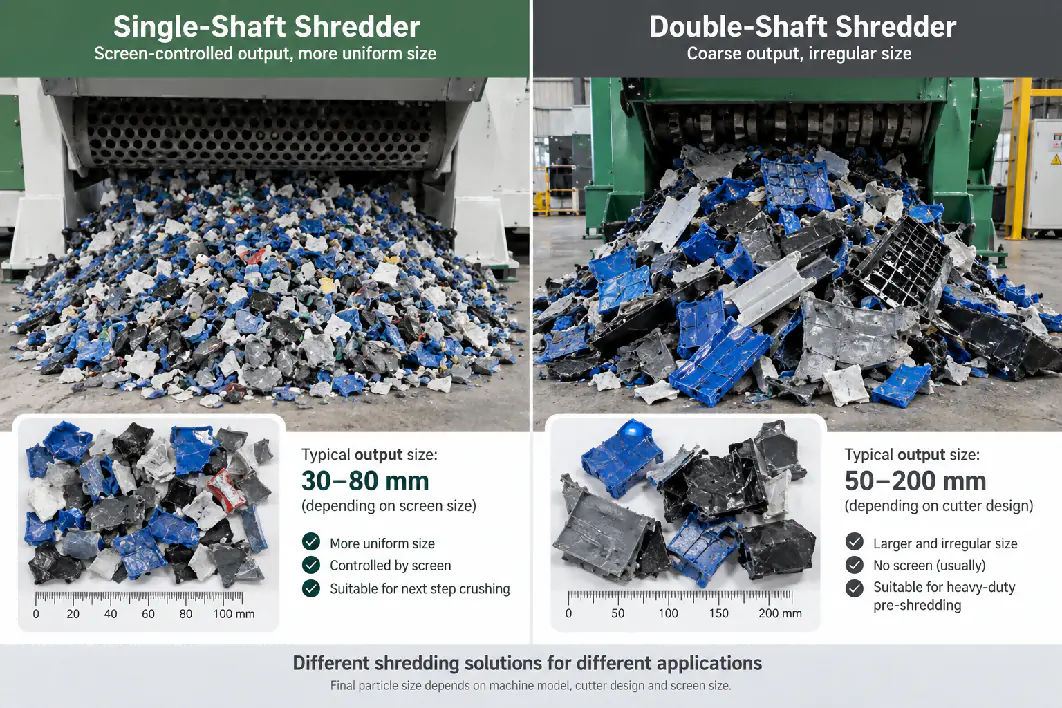
The presence or absence of a screen is one of the most practical differences between the two designs.
On a single-shaft shredder, material normally remains in the cutting chamber until it is small enough to pass through the screen. A smaller screen opening gives smaller output, but also increases cutting cycles, reduces throughput and increases blade and screen wear. For this reason, the screen should be selected according to the next process rather than choosing the smallest possible opening.
On a typical double-shaft primary shredder, there may be no screen. Output size is influenced by cutter width, hook design and the way the material breaks apart. This is acceptable when the goal is simply to reduce volume or prepare material for a second machine, but it is less suitable when the next process requires a narrow flake-size range.
Film and woven bags: why feeding control matters
Flexible plastics deserve special attention because they behave very differently from rigid products. Film and woven bags are light, elastic and easy to wrap around rotating components. Their low bulk density also means that a large hopper volume does not necessarily translate into high mass throughput.
For baled film, agricultural film, raffia and woven bags, a single-shaft shredder with a hydraulic pusher is often a practical choice because the pusher compresses the material and feeds it into the rotor in a controlled way. Rotor geometry, knife layout and anti-wrapping details become more important than simply installing a larger motor.
If the material is heavily contaminated with soil, sand or stones, dry pre-cleaning should also be considered. Abrasive contamination increases knife and screen wear and can reduce the service life of downstream equipment.
Pallets, bins and large rigid products
For plastic pallets, bins and large crates, both shredder types can be technically possible, but the correct choice depends on how the line is intended to operate.
If the project requires a controlled intermediate size before a crusher, washing line or extruder, a single-shaft shredder is often easier to integrate because of its screen and controlled pushing system. If the products are extremely bulky, irregular or mixed with other large industrial waste and the main requirement is aggressive primary tearing, a double-shaft shredder may be more suitable.
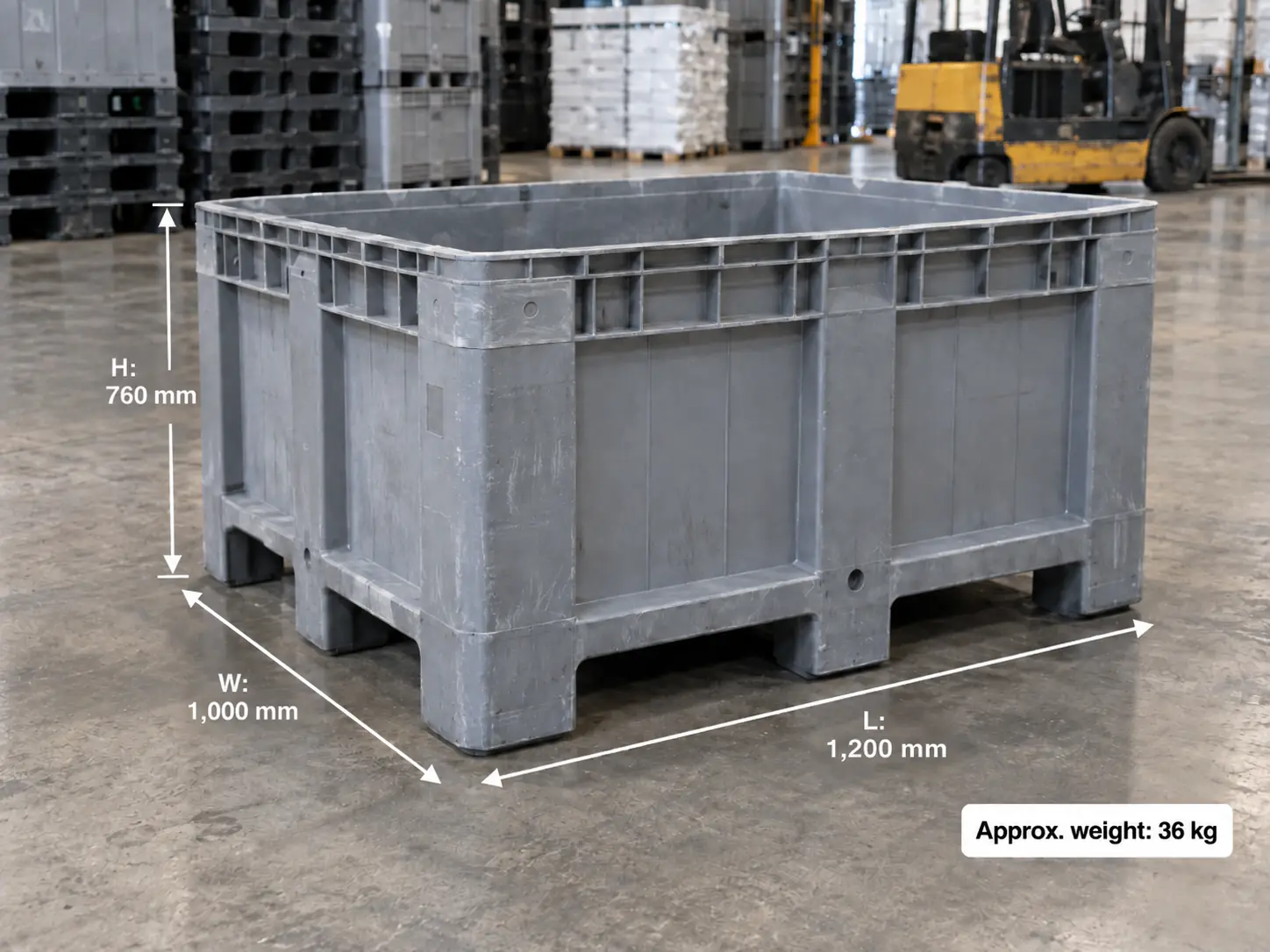
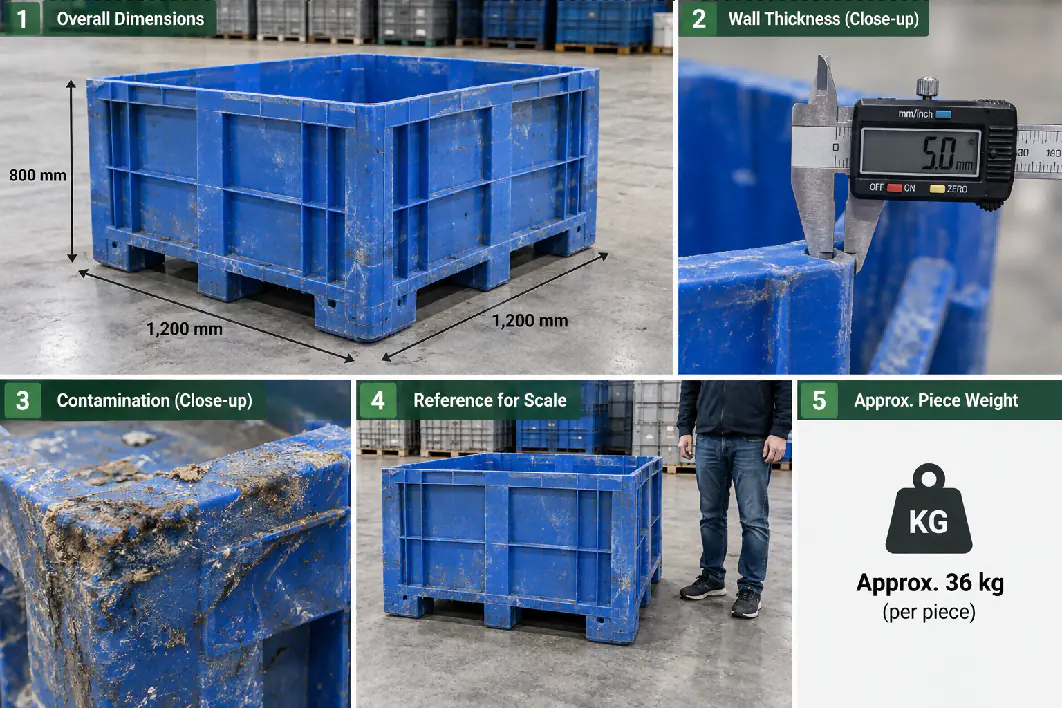
The dimensions of one complete item should always be provided. A 600 mm crate and a 1,200 mm industrial bin may have similar material type and weight per kilogram of output, but they require very different hopper openings, rotor widths and feeding arrangements.
Metal contamination changes the recommendation
Plastic waste may contain metal inserts, screws, hinges, reinforcement or accidental metal contamination. This must be discussed before selecting a shredder.
A double-shaft shredder can tolerate some difficult mixed feed better than a fine crusher, but metal still causes cutter wear and can damage shafts, spacers and bearings. A single-shaft shredder is also not a metal-processing machine; large or hard metal pieces should be removed whenever possible.
For recycling lines where metal contamination is expected, a magnetic separator can be installed after primary shredding and before the crusher. This protects the finer downstream machine and reduces the chance of metal reaching the washing or extrusion section.
Do not choose by motor power alone
A 75 kW single-shaft shredder and a 75 kW double-shaft shredder are not equivalent machines. Motor power alone does not tell you how much waste the machine can process.
For a single-shaft shredder, important factors include rotor diameter, effective rotor width, knife size and quantity, screen opening, hydraulic pusher stroke and force, gearbox torque, feeding chamber volume and control logic.
For a double-shaft shredder, shaft diameter, cutter thickness, hook geometry, cutter overlap, gearbox torque, shaft spacing and frame strength all influence performance. The same installed motor power can produce very different results depending on the mechanical design and the actual waste.
Capacity should therefore be discussed together with the material form and required output size. A supplier should not recommend a shredder only from a target such as ‘1,000 kg/h’ without seeing photos, dimensions and information about the waste.
When should a shredder be followed by a crusher?
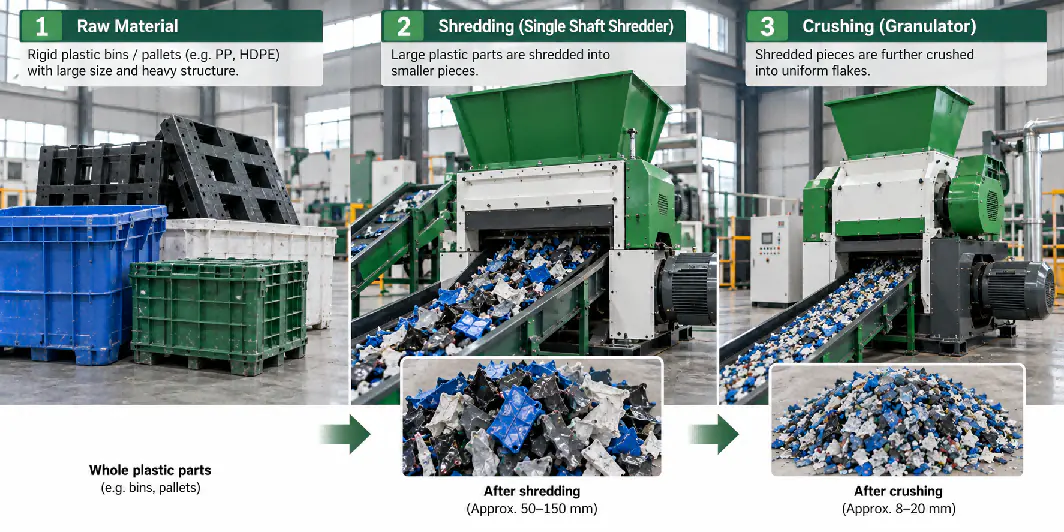
A shredder is usually the first-stage machine. If the downstream process requires smaller, more uniform flakes, a crusher can be added after shredding.
Typical examples include large bins, pallets, thick purge, large pipe scrap and bulky drums. The shredder solves the feeding and bulk-reduction problem. The crusher then reduces the pre-shredded pieces to the final size needed for washing, drying, pneumatic conveying or extrusion.
This two-stage approach can be more stable than trying to make one very large crusher accept the complete product directly. It also allows each machine to work in the size-reduction range for which it is best suited.
What information should you provide before asking for a quotation?
To choose between a single-shaft and double-shaft shredder, the supplier should see the real waste rather than only the polymer name.
- Plastic type: PP, PE, HDPE, LDPE, LLDPE, ABS, PVC or mixed plastics.
- Product form: film, woven bags, crates, bins, pallets, drums, lumps, pipes or other products.
- Maximum dimensions and approximate weight of one complete item.
- Wall thickness or material thickness where relevant.
- Whether the material is loose, baled, compacted or nested.
- Presence of metal, sand, stones, labels, rope, textile or other contamination.
- Required throughput in kg/h.
- Required discharge size or downstream machine.
- Whether the next step is washing, crushing, pelletizing, extrusion or direct reuse.
For unusual materials, photos and a short running video are often more useful than a long written description. A material trial is the most reliable way to confirm feeding behavior, realistic throughput and discharge size before the final machine configuration is fixed.
Final selection: match the shredder to the job
Single-Shaft Shredder
Choose a single-shaft shredder when controlled feeding, a screened discharge size and stable integration with the next recycling stage are important. This is why single-shaft machines are common in plastic film, woven bag, rigid-plastic and purge recycling lines.
Double-Shaft Shredder
Choose a double-shaft shredder when the main challenge is grabbing and tearing very bulky, irregular or mixed waste and a coarse primary output is acceptable. If the final material must be smaller and more uniform, plan for a crusher downstream.
The best choice is not determined by the number of shafts, the largest motor or the heaviest machine. It is determined by the waste form, feeding behavior, required output size and the equipment that comes next.
Frequently asked questions
Is a double-shaft shredder stronger than a single-shaft shredder?
Not automatically. A double-shaft shredder has stronger self-grabbing and tearing for bulky, irregular waste, while a single-shaft shredder offers controlled feeding and a screened discharge size. The right choice depends on the job the shredder must perform.
Which shredder is better for plastic film and woven bags?
A single-shaft shredder with a hydraulic pusher is often the practical choice, because the pusher compresses light, elastic material and feeds it into the rotor in a controlled way. Rotor geometry, knife layout and anti-wrapping details matter more than a larger motor.
Does a double-shaft shredder need a crusher after it?
Often, yes. Many primary double-shaft designs have no sizing screen, so output is coarse and irregular. If the next process needs smaller, more uniform flakes, a crusher is usually installed downstream.
Can shredders be compared by motor power?
No. A 75 kW single-shaft and a 75 kW double-shaft shredder are not equivalent. Rotor or shaft dimensions, knives, screen, pusher, gearbox torque and the actual waste determine real capacity.
Is a twin-shaft or dual-shaft shredder the same as a double-shaft shredder?
Yes. Twin-shaft, dual-shaft, two-shaft and double-shaft are different names for the same design: two counter-rotating shafts with intermeshing cutters that grab and tear the material. Specifications still differ by manufacturer, so compare shaft diameter, cutter thickness, torque and chamber size rather than the name.
When is a four-shaft shredder used?
A four-shaft shredder adds a second pair of shafts, giving finer and more uniform output in a single pass. It suits mixed solid waste, e-waste and similar applications. For most plastic recycling lines, a single-shaft shredder, or a double-shaft shredder followed by a crusher, is simpler and easier to maintain.
Material-specific recommendation
Not sure which machine fits your waste?
Send us photos and a few details of the real material. Our engineers will recommend a suitable size-reduction configuration and, where needed, arrange a material trial.
Request a recommendation- Photos or a short video of the waste
- Dimensions and weight of one piece
- Required throughput and output size
- The next process step