Plastic Crusher Blades (Granulator Knives): Material, Knife Gap, Wear and Maintenance
The blades are one of the most important parts of a plastic crusher. Two machines with similar motor power and cutting-chamber size can perform very differently if their knife material, blade geometry, knife gap and maintenance condition are different. Poor blade condition can reduce output, increase current draw, produce irregular flakes, create excessive heat and place unnecessary load on the rotor, bearings and motor.
The short answer
A good blade should hold its edge long enough for the intended material while still having enough toughness to survive normal operating loads. The knife gap should create a clean shearing action without risking blade contact. Sharpening should be carried out before severe wear develops, and both moving and fixed knives should be maintained as a matched cutting pair.
Contents
- 01Moving knives and fixed knives: what each one does
- 02Common blade materials used in plastic crushers
- 03Blade hardness: harder is not always better
- 04Knife gap is one of the most important adjustments
- 05How the raw material affects knife-gap selection
- 06What happens when crusher blades become dull
- 07Contamination is often the real cause of rapid blade wear
- 08When should crusher blades be sharpened?
- 09Correct blade sharpening matters as much as blade material
- 10Knife bolts and blade seats also require maintenance
- 11Screen size and blade wear are connected
- 12Wet crushing can reduce heat, but blade maintenance is still essential
- 13Spare blades: what a buyer should order with a new crusher
- 14What information should you provide when selecting crusher blades?
- 15Shredder blades vs crusher knives: what is different?
- 16Final selection: blade quality is part of crusher performance
- Frequently asked questions
Moving knives and fixed knives: what each one does
For buyers, it is therefore not enough to ask only how many blades a plastic crusher has. The more useful questions are: what steel is used, how hard the knives are, how the moving and fixed knives are arranged, what knife clearance is required for the material, how easily the blades can be adjusted or removed, and how often they can be sharpened before replacement.
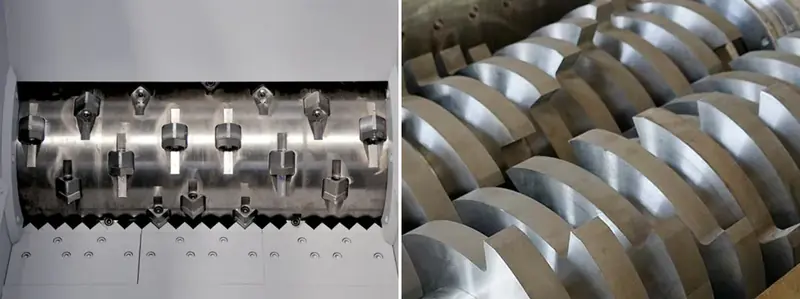
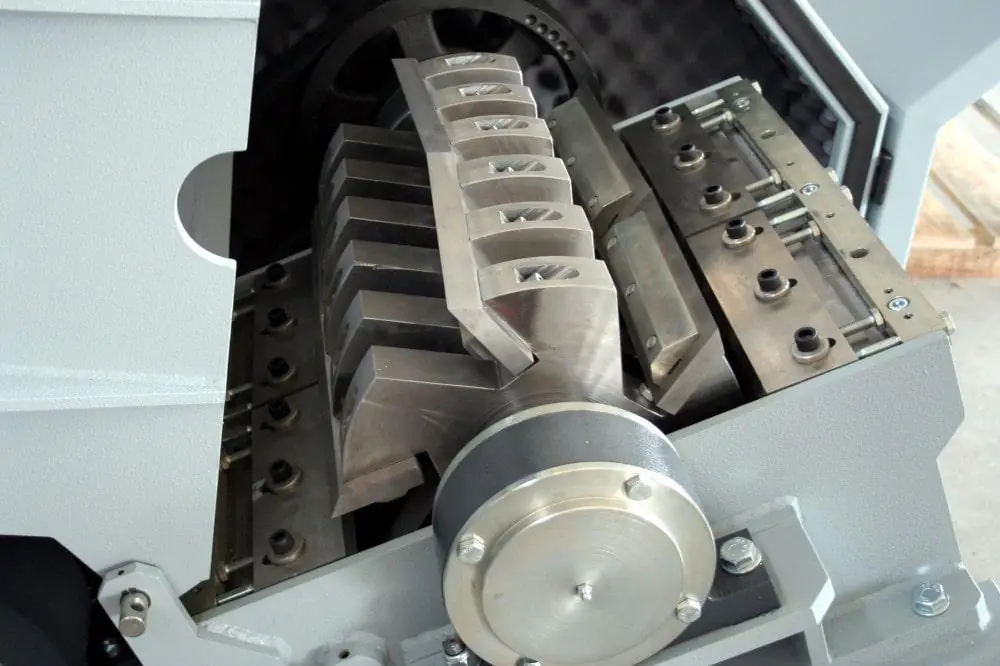
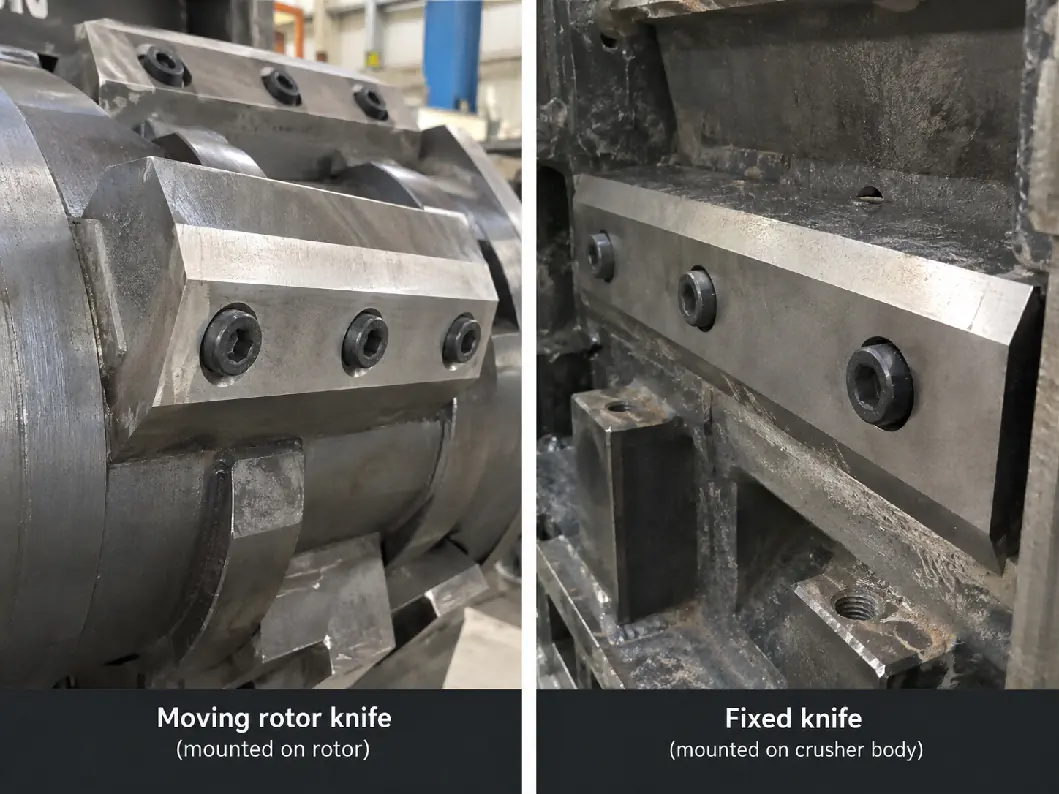
A typical plastic crusher cuts material between moving knives mounted on the rotor and fixed knives mounted on the crusher body. The moving knives pass very close to the fixed knives, creating a shearing action. The plastic remains in the chamber until the pieces are small enough to pass through the screen.
The moving knives do most of the repeated cutting work and are exposed to impact, friction and contamination. The fixed knives provide the opposing cutting edge. Both must remain sharp and correctly aligned. A sharp moving knife with a worn fixed knife will still give poor cutting performance.
Depending on the crusher design, the rotor may use straight knives, staggered knives, V-cut arrangements or segmented blades. The best arrangement depends on the feed material. Bottles, thick rigid scrap, injection-molding runners and film do not enter the cutting zone in the same way, so blade geometry should be matched to the application rather than selected only by blade quantity.
Common blade materials used in plastic crushers
Crusher blades need a balance of hardness, wear resistance and toughness. A very hard blade may resist abrasion well but can become more sensitive to chipping if metal or stones enter the machine. A tougher blade may survive impact better but may require more frequent sharpening. This is why the raw material and contamination level should be considered before specifying knife steel.
| Blade material | Typical characteristics | Suitable use | Points to consider |
|---|---|---|---|
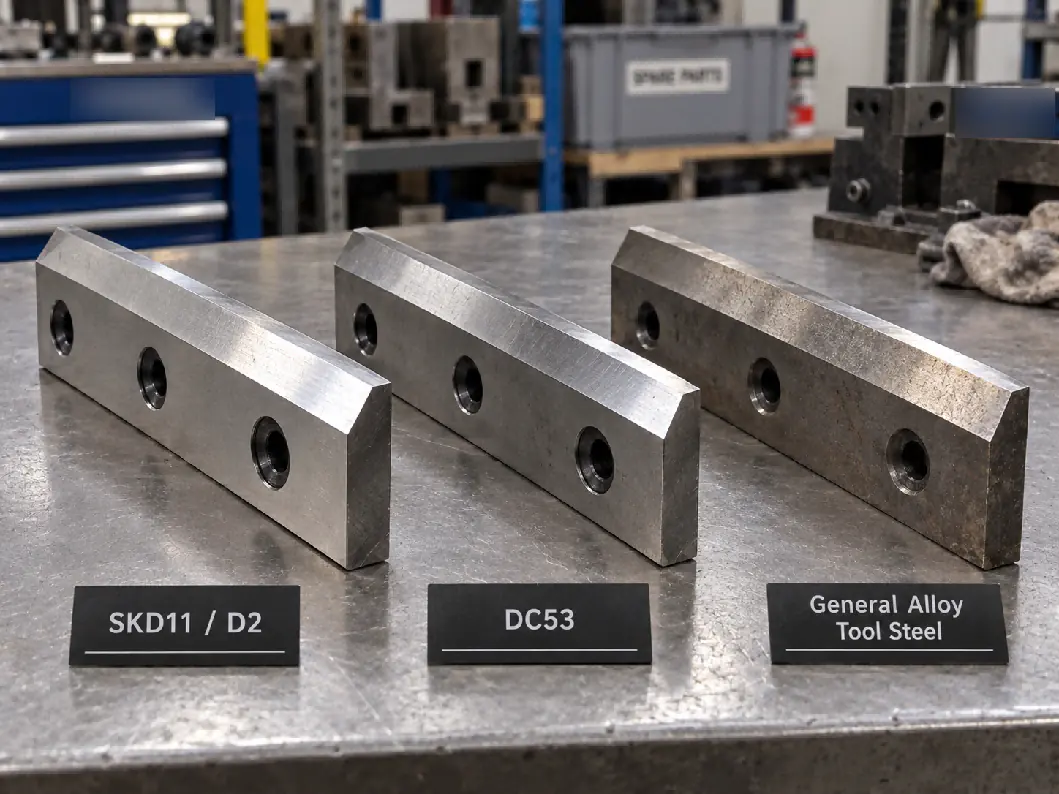
| SKD11 / D2 | High wear resistance and good edge retention | General rigid-plastic crushing, bottles, crates, runners and recycled plastic | Common choice for industrial plastic crushers; correct heat treatment is critical |
| DC53 | High hardness with improved toughness compared with conventional D2 in many tooling applications | Heavy-duty applications where chipping resistance is important | Higher cost; performance depends strongly on heat treatment |
| 9CrSi / similar alloy tool steels | Moderate wear resistance and lower cost | Less abrasive, lighter-duty applications | Usually requires more frequent sharpening than premium tool steels |
| High-speed steel / special tool steels | Very good hardness and wear resistance | Specialized applications requiring long edge life | Higher cost and not always necessary for standard recycling lines |
For many plastic recycling projects, SKD11/D2 is a practical and widely used choice because it provides a good balance between price and wear resistance. However, the steel grade printed on a quotation does not guarantee blade quality. Heat treatment, tempering, grinding accuracy and final hardness are equally important.
For this reason, buyers should ask the supplier not only for the material grade, but also for the target hardness range and the blade heat-treatment standard. A well-made D2 knife can outperform a poorly heat-treated knife made from a more expensive steel.
Blade hardness: harder is not always better
Plastic crusher knives are normally heat-treated to achieve high hardness, but selecting the highest possible hardness is not always the correct approach. If the blade becomes too brittle, accidental metal contamination or heavy impact can chip the cutting edge.
For D2/SKD11 crusher knives, suppliers commonly work within a high-hardness tool-steel range, often around the upper-50s HRC depending on the blade size and application. The exact value should be determined by the knife manufacturer because thick heavy-duty blades, thin knives and highly contaminated applications may require different hardness-toughness balances.
For clean PET bottles or production scrap, wear resistance is usually the main concern. For dirty rigid plastic, agricultural material or scrap with possible metal contamination, toughness becomes more important. In these cases, choosing a slightly tougher blade and protecting the crusher with sorting or magnetic separation may give better overall operating cost than simply maximizing hardness.
Knife gap is one of the most important adjustments
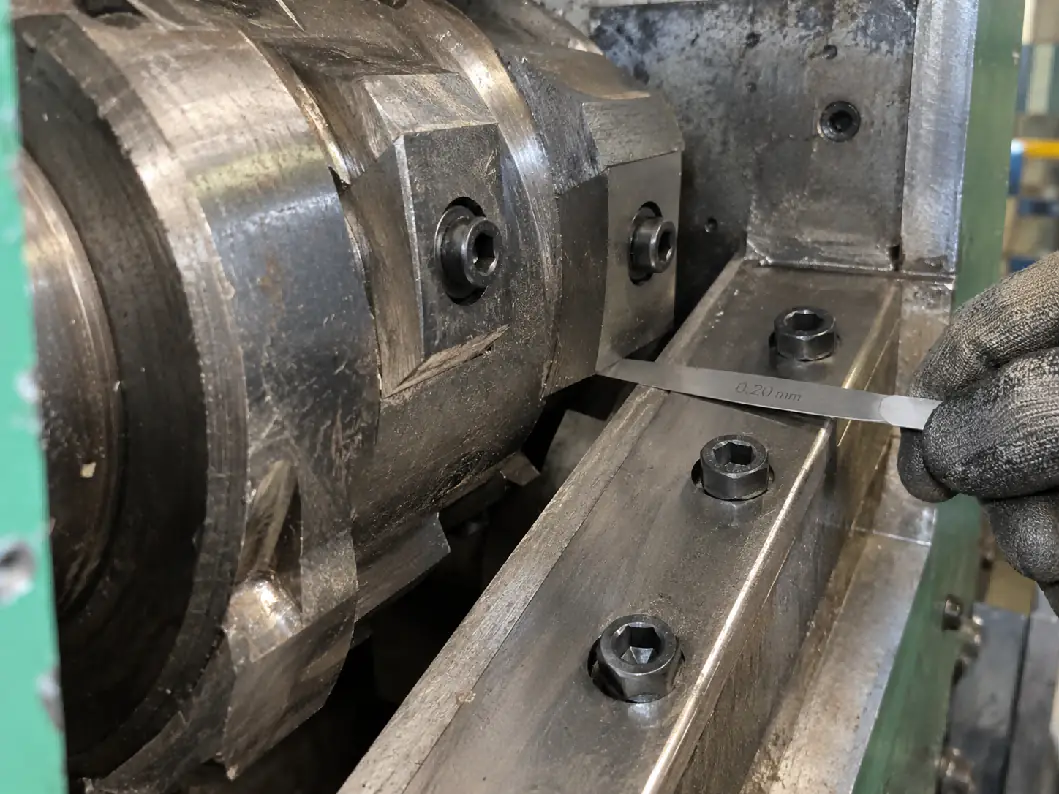
The knife gap is the clearance between the moving knife and the fixed knife at the cutting point. This gap must be small enough to create a clean shearing action, but large enough to prevent knife contact when the rotor runs under load.
If the knife gap is too large, the machine begins to tear or beat the plastic instead of cutting it cleanly. This can reduce capacity, increase flake size variation and create more heat. Flexible materials may fold or stretch through the gap instead of being cut.
If the knife gap is too small, the moving and fixed knives may touch because of rotor deflection, bearing movement, thermal expansion or incorrect adjustment. Knife collision can damage the blades, blade seats and rotor and may cause a sudden machine stop.
There is no single knife-gap value suitable for every crusher. In many conventional plastic crushers the working clearance is measured in tenths of a millimeter, but the correct value depends on rotor diameter, machine accuracy, knife thickness, material type and crusher design. The manufacturer’s specified adjustment range should always be followed.
How the raw material affects knife-gap selection
Rigid plastic and flexible plastic place different demands on the cutting system. Thick PP or HDPE pieces can tolerate a slightly larger cutting clearance than very thin film because the material is stiff enough to be sheared cleanly. Thin film and woven material are more likely to fold or pull through a large gap.
For PET bottle crushing, sharp knives and consistent clearance are important because dull blades can generate excess PET fines and irregular flakes. In wet crushing, water helps reduce frictional heat and starts removing dirt, but it does not compensate for poor blade condition.
For thick lumps, purge and heavily molded parts, blade toughness and stable knife mounting become especially important because the cutting load changes rapidly as the rotor bites into dense material.
For dirty agricultural plastic, sand and mineral contamination act like abrasive media. In these applications, maintaining a perfect sharp edge for long periods is unrealistic. Pre-cleaning can often save more blade cost than upgrading to a much more expensive knife steel.
What happens when crusher blades become dull
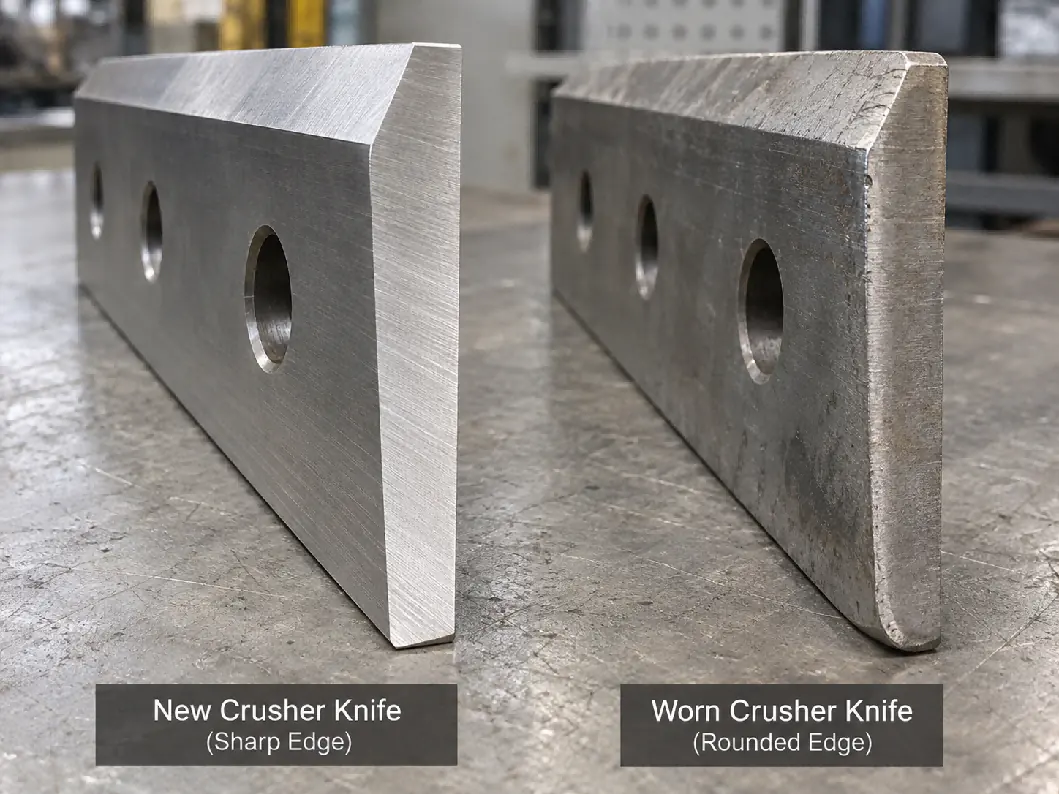
Blade wear develops gradually, so operators often continue production without noticing how much performance has deteriorated. The first sign is not always a visible damaged knife. Changes in machine behavior often appear earlier.
| Operating symptom | Possible blade-related cause | What to check |
|---|---|---|
| Capacity gradually falls | Cutting edges becoming rounded | Inspect moving and fixed knives; compare current gap with setup value |
| Motor current increases | More crushing by impact instead of shearing | Knife sharpness, gap, screen blockage and feed rate |
| Flakes become larger or irregular | Worn edges or excessive knife clearance | Knife condition and fixed-knife alignment |
| More dust or fines | Damaged edge, excessive repeated cutting or unsuitable screen | Blade chipping, screen size and rotor condition |
| Material wraps or stretches | Knives too dull or gap too large | Especially important for film and raffia |
| Abnormal vibration or noise | Loose knife bolts, chipped blades or rotor imbalance | Stop the machine and inspect immediately |
Contamination is often the real cause of rapid blade wear
Knife life is strongly influenced by what enters the crusher with the plastic. Sand, glass, stones, screws, metal inserts and mineral powder can shorten blade life much faster than clean plastic.
Sand and fine mineral contamination cause abrasive wear along the entire cutting edge. Metal pieces can cause local chipping or breakage. Stones can damage both the knives and the screen. This is why the same blade may run for a long time on clean factory scrap but require much more frequent maintenance when processing post-consumer or agricultural waste.
If ferrous metal contamination is possible, an overband magnet or magnetic separator can be installed before the crusher. For large foreign objects, manual sorting or a pre-cleaning stage may still be necessary because not all harmful contamination is magnetic.
When should crusher blades be sharpened?
There is no reliable universal answer such as ‘sharpen every 500 hours.’ The correct interval depends on the material, contamination, screen size, feed rate and operating hours.
A better maintenance rule is to sharpen the knives when cutting performance begins to deteriorate, before the edge becomes heavily rounded or chipped. Continuing to run very dull blades increases power consumption and can remove more blade material during the next grinding operation, shortening total blade life.
Operators should record running hours, processed material and sharpening dates. After several maintenance cycles, the plant can establish a realistic sharpening interval for its own waste stream.
When knives are removed, both moving and fixed knives should be inspected. Regrinding only one side of the cutting pair may not restore proper cutting performance if the opposite knife is also worn.
Correct blade sharpening matters as much as blade material
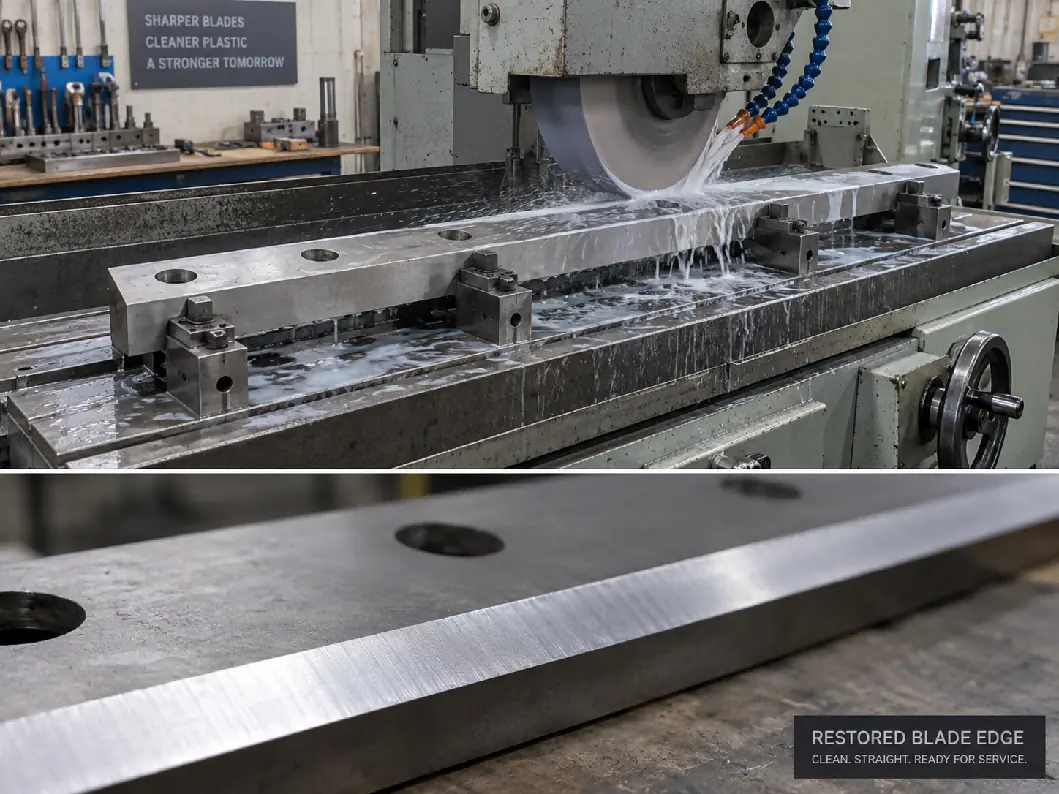
Crusher knives should be ground on appropriate machine tools so that the cutting edge remains straight and the blade dimensions remain consistent across the rotor. Uneven grinding can make knife-gap adjustment difficult and may create rotor imbalance.
During grinding, excessive heat should be avoided because overheating can affect the heat-treated cutting edge. The sharpening angle should remain consistent with the original blade design unless the machine manufacturer specifies a different angle for a particular application.
After sharpening, all blades mounted in the same rotor position group should be checked for dimensional consistency. If one knife projects farther than the others, it may carry excessive load or contact the fixed knife.
Knife bolts and blade seats also require maintenance
Blade maintenance is not limited to the cutting edge. Knife bolts, threaded holes and blade seats carry repeated impact loads. Loose bolts can allow the knife to move, damaging the seat and creating serious rotor imbalance.
Before reinstalling blades, the mounting surfaces should be cleaned. Plastic residue, rust or crushed material trapped under the knife can change the knife position and make accurate gap adjustment impossible.
Bolts should be tightened according to the manufacturer’s torque requirement and rechecked after initial running if specified. Damaged threads or deformed blade seats should be repaired before production continues.
Screen size and blade wear are connected
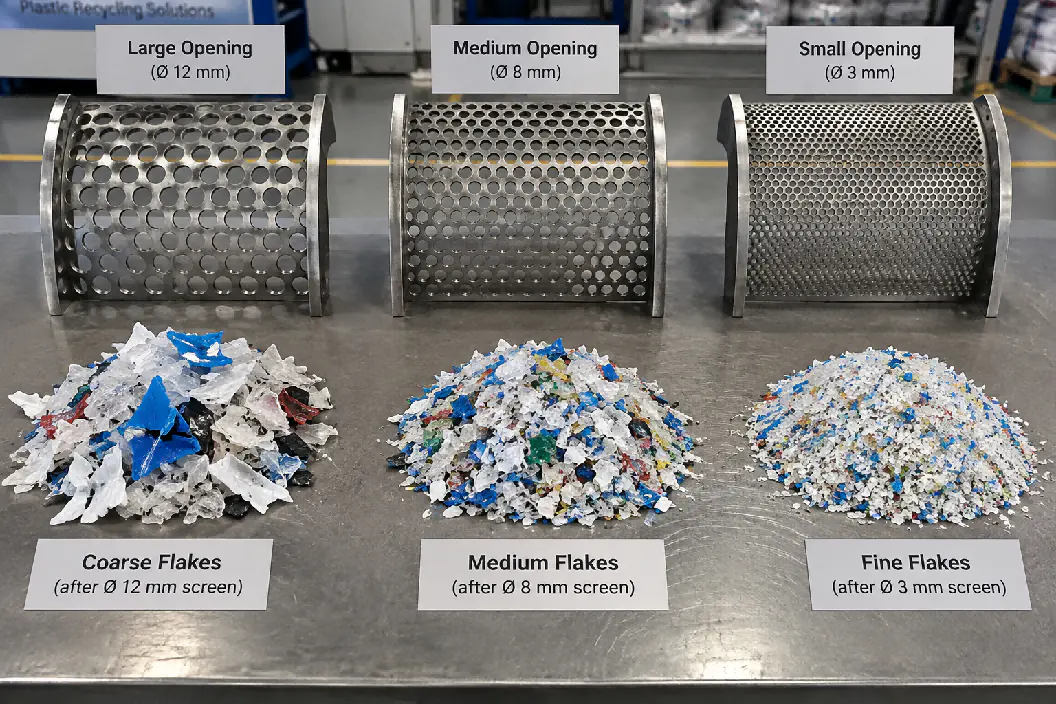
A smaller crusher screen does not only change the final particle size. It also keeps material inside the cutting chamber for more cutting cycles. This increases contact between the plastic and the knives.
For example, changing from a larger screen to a much smaller opening may improve flake size but can reduce throughput and increase blade wear. The smallest possible screen is therefore not always the most economical choice.
The screen should be selected according to the next process. A washing line may require flakes small enough for effective friction washing and float-sink separation, while an extrusion line may have different feeding requirements. The best screen opening is the one that meets the downstream requirement without unnecessary repeated cutting.
Wet crushing can reduce heat, but blade maintenance is still essential
Wet crushing is commonly used in PET bottle and some rigid-plastic washing lines. Water enters the cutting chamber during crushing, helping reduce frictional heat and begin removing dirt from the plastic.
However, wet operation does not eliminate blade wear. Abrasive contaminants can still attack the cutting edge, and poor-quality water or inadequate drainage can create corrosion problems during shutdown periods.
Wet-crusher knives and mounting areas should therefore be cleaned and inspected during planned maintenance. If the line will remain idle for a long period, the machine should be drained and protected against corrosion according to the supplier’s maintenance procedure.
Spare blades: what a buyer should order with a new crusher
For a production line that must operate continuously, spare knives should be included in the initial spare-parts plan. Waiting for a replacement blade after damage can stop the entire washing or pelletizing line.
A practical spare set normally includes moving knives, fixed knives and critical mounting hardware. The required quantity depends on machine design and the plant’s maintenance strategy.
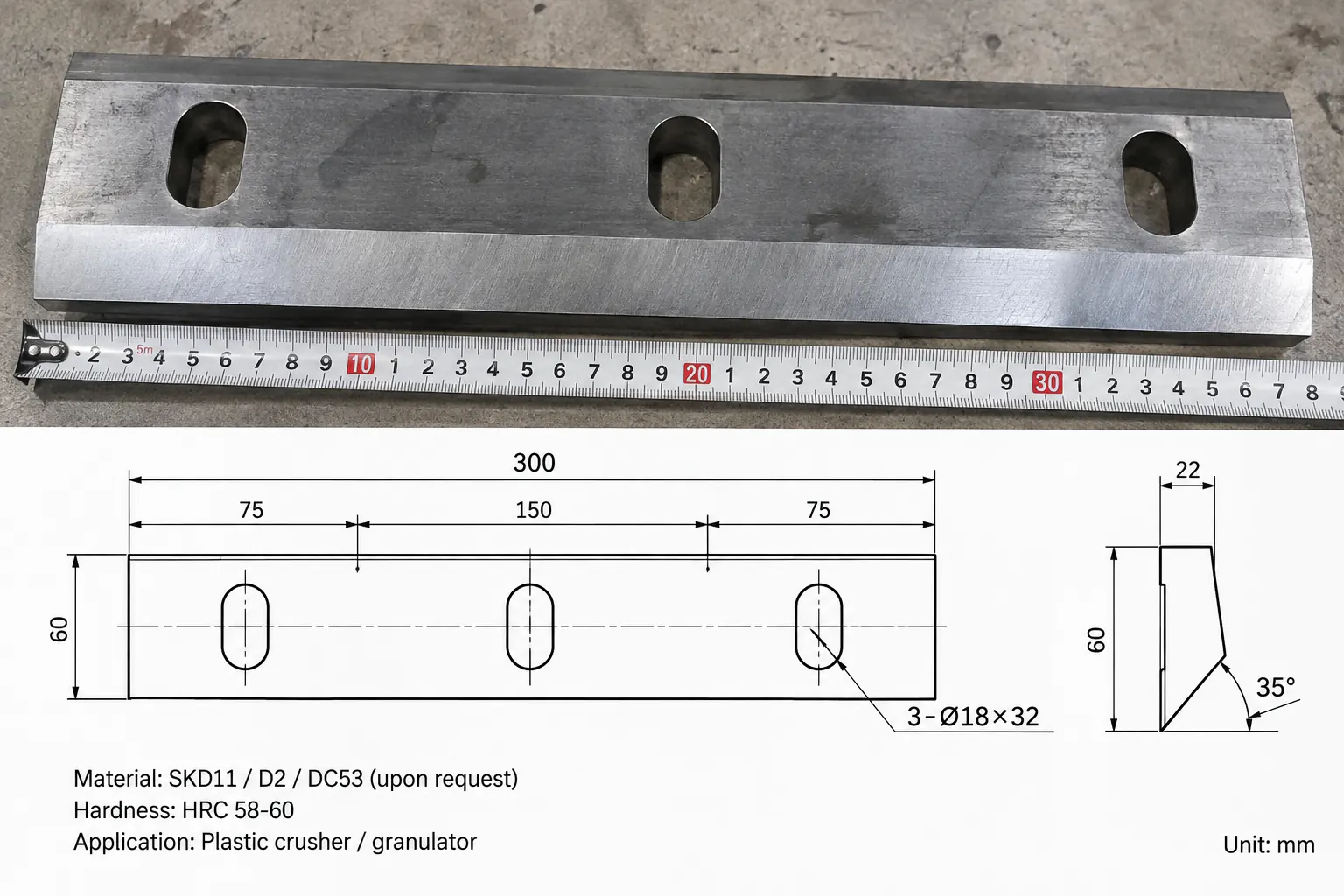
When ordering spare knives later, the customer should provide the machine model, blade drawing or exact dimensions, mounting-hole pattern, material grade and hardness requirement. Small differences in hole position or knife thickness can prevent proper installation even when the overall blade length looks correct.
What information should you provide when selecting crusher blades?
If you are buying a crusher or replacement knives, the supplier should understand the actual application. Useful information includes:
- Plastic type: PET, HDPE, PP, ABS, PVC or mixed rigid plastic.
- Product form: bottles, crates, runners, lumps, pipes, sheet or other scrap.
- Maximum feed size and wall thickness.
- Required throughput in kg/h.
- Target flake size and crusher screen opening.
- Whether crushing is dry or wet.
- Contamination: sand, metal, labels, glass, stones, cement or mineral residue.
- Current blade material and hardness if replacing an existing knife.
- Blade dimensions, mounting-hole pattern and a clear photo or drawing.
For replacement blades, a dimensioned drawing is more reliable than a photo alone. Length, width, thickness, hole position, countersink details and edge angle should all be confirmed before production.
Shredder blades vs crusher knives: what is different?
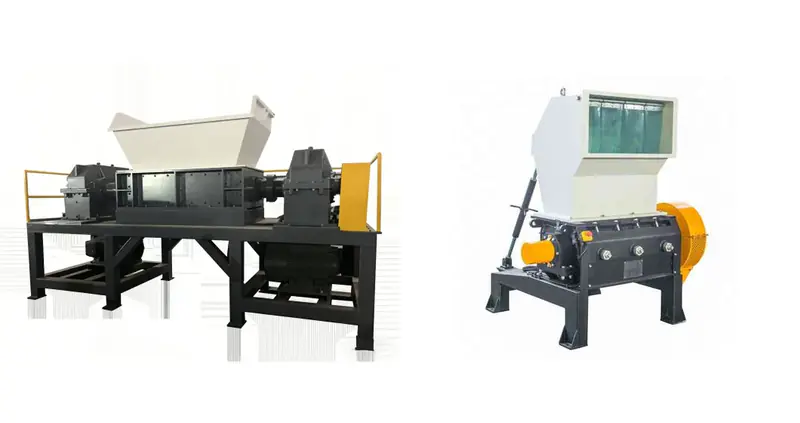
Buyers often search for shredder blades and crusher blades as if they were interchangeable, but the parts work very differently. Crusher and granulator knives are long, flat blades that cut at high speed against fixed bed knives across a small, precisely set gap. Shredder blades run at low speed and high torque, so they are shaped for impact and tearing rather than a precise scissor cut.
A single-shaft shredder uses small square or profiled rotor knives, often with several usable edges that can be rotated before regrinding, cutting against a counter knife above a screen. A double-shaft shredder uses thick hooked cutter discs stacked on the shafts with spacers; worn cutters are usually hard-faced or replaced as a set rather than sharpened like a crusher knife.
| Feature | Crusher / granulator knives | Single-shaft shredder knives | Double-shaft shredder cutters |
|---|---|---|---|
| Shape | Long flat rotor and bed knives | Small square or profiled inserts | Thick hooked discs with spacers |
| Cutting action | High-speed scissor cut across a set gap | Low-speed cut against a counter knife | Low-speed tearing and shearing between shafts |
| Typical steel | Tool steels such as SKD11/D2 or DC53 | Tool or alloy steels, often with several usable edges | Tough alloy steels chosen for impact resistance |
| Maintenance | Regrind, then reset the knife gap | Rotate to a fresh edge, then regrind or replace | Hard-face or replace cutters; check spacers and bearings |
When ordering spare blades, give the machine model and the rotor or shaft dimensions, not only the word ‘blade’. To choose between the two shredder designs themselves, see single-shaft vs double-shaft shredders.
Final selection: blade quality is part of crusher performance
Crusher performance is determined by the entire cutting system, not only the motor. Blade steel, heat treatment, knife geometry, knife gap, screen size, rotor accuracy and maintenance all work together.
A good blade should hold its edge long enough for the intended material while still having enough toughness to survive normal operating loads. The knife gap should create a clean shearing action without risking blade contact. Sharpening should be carried out before severe wear develops, and both moving and fixed knives should be maintained as a matched cutting pair.
For buyers comparing plastic crushers, asking about blade material, hardness, adjustment method and spare-knife availability often reveals more about the machine’s practical operating quality than simply comparing motor power or blade quantity.
Frequently asked questions
What is the best steel for plastic crusher blades?
For many recycling projects SKD11/D2 is a practical choice with a good balance of price and wear resistance; DC53 offers better chipping resistance for heavy-duty work. Heat treatment, tempering and grinding accuracy matter as much as the steel grade.
What knife gap should a plastic crusher have?
There is no single value. In many conventional crushers the working clearance is measured in tenths of a millimetre, but it depends on rotor diameter, machine accuracy, knife thickness and material. Follow the manufacturer’s adjustment range.
How often should crusher blades be sharpened?
There is no universal interval. Sharpen when cutting performance starts to fall, before the edge becomes heavily rounded or chipped, and record running hours to set a realistic interval for your own material.
Why do crusher blades wear out so quickly?
Contamination is often the real cause: sand, glass, stones and metal wear or chip the edge far faster than clean plastic. Pre-cleaning, sorting and magnetic separation before the crusher protect the knives.
Are granulator blades the same as crusher blades?
Yes. Granulator blades, granulator knives and plastic crusher blades refer to the same rotor and bed knives that cut plastic against a screen. The selection rules in this guide — steel, hardness, knife gap and sharpening — apply to both.
Can crusher knives be used in a shredder?
No. Shredder blades and crusher knives differ in shape, cutting speed and duty. A single-shaft shredder uses small rotatable knife inserts and a double-shaft shredder uses hooked cutter discs, so spare parts must match the specific machine and rotor or shaft dimensions.
Spare blades
Need replacement crusher or granulator blades?
Send your machine details and a photo or drawing of the current knives. We will confirm the blade steel, dimensions and the right spare set for your crusher.
Ask about replacement blades- Crusher model or rotor diameter and width
- Blade drawing, dimensions or photos
- Material being crushed and its contamination
- Current blade life between sharpenings