PET Bottle Label Remover: Why Labels Must Come Off Before Crushing
Label removal is one of the most underestimated steps in a PET bottle washing line. A label may be only a small share of the bale weight, but once it is crushed together with the bottle it becomes thousands of small pieces that are much harder to separate. That is why high-quality lines remove as much label material as possible while the bottle is still whole.
The short answer
A PET bottle label remover (also called a delabeler) is installed after bale opening and before the crusher. A rotor with scraping elements tears sleeves and labels off whole bottles without crushing them, and an air-separation stage blows the light labels away from the heavier bottles. Under suitable conditions, well-designed machines remove more than 90% of suitable labels, but the real result depends on bale compression, label type and adhesive. Judge a machine by a trial with your own bottles — label removal rate, bottle breakage and PET loss — not by motor power. It does not remove glue or replace float-sink separation, hot washing or a final zig-zag label separator.
Contents
- 01Why labels become a bigger problem after crushing
- 02Not all PET bottle labels are the same
- 03PVC and PETG shrink sleeves need special attention
- 04How a PET bottle label remover machine works
- 05Scraping and blowing are two different functions
- 06What label removal rate should you expect?
- 07Why compressed PET bales are harder to delabel
- 08A label remover should not become a bottle crusher
- 09Removing labels before wet crushing reduces the downstream load
- 10Label removal improves float-sink separation but does not replace it
- 11Label removal does not remove glue
- 12Where should the label remover go in a PET recycling line?
- 13Zig-zag label separator after washing and drying
- 14Label type determines the best machine setting
- 15What affects label removal efficiency?
- 16Conclusion: remove labels while they are still labels
- Frequently asked questions
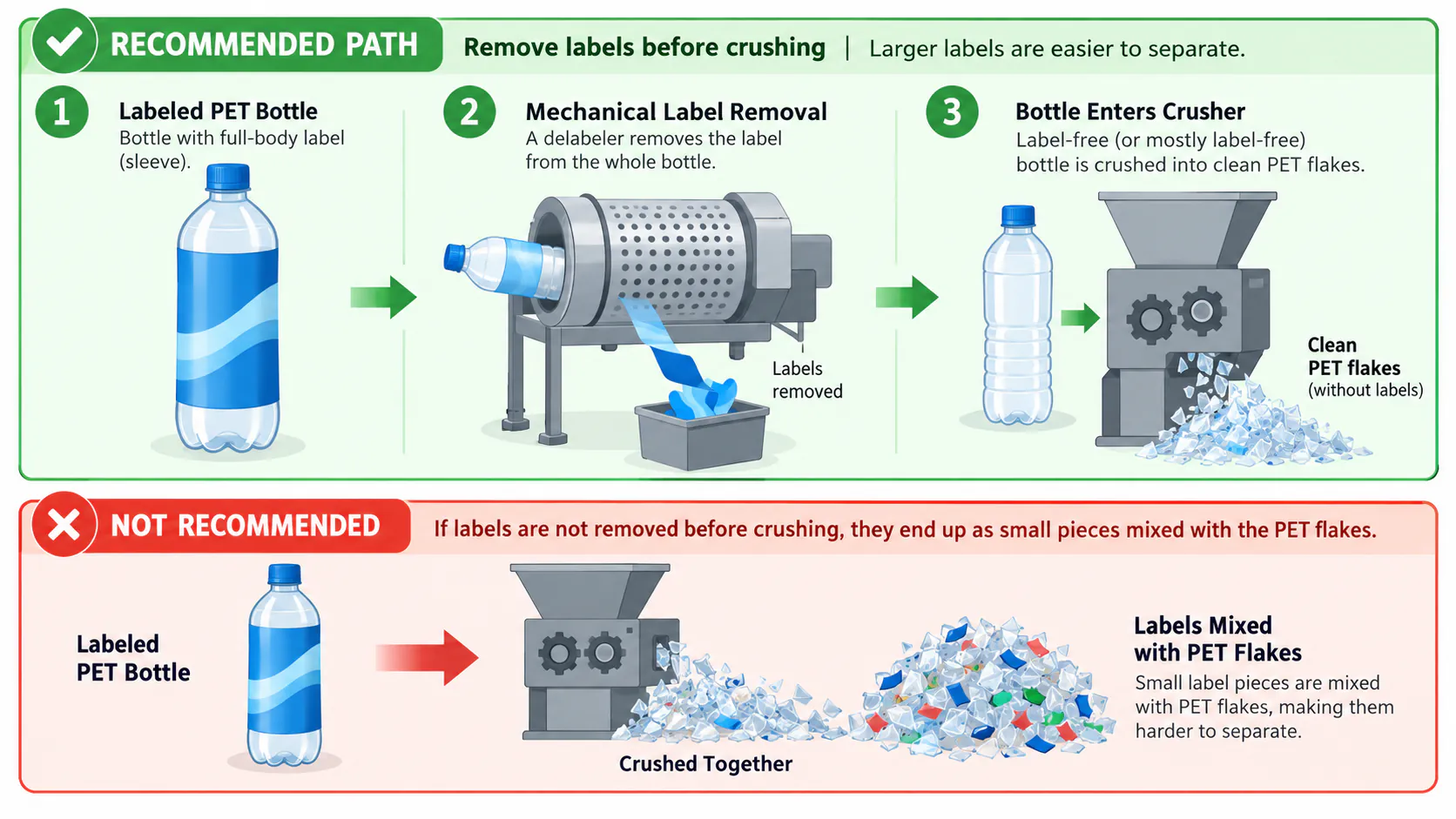
Why labels become a bigger problem after crushing
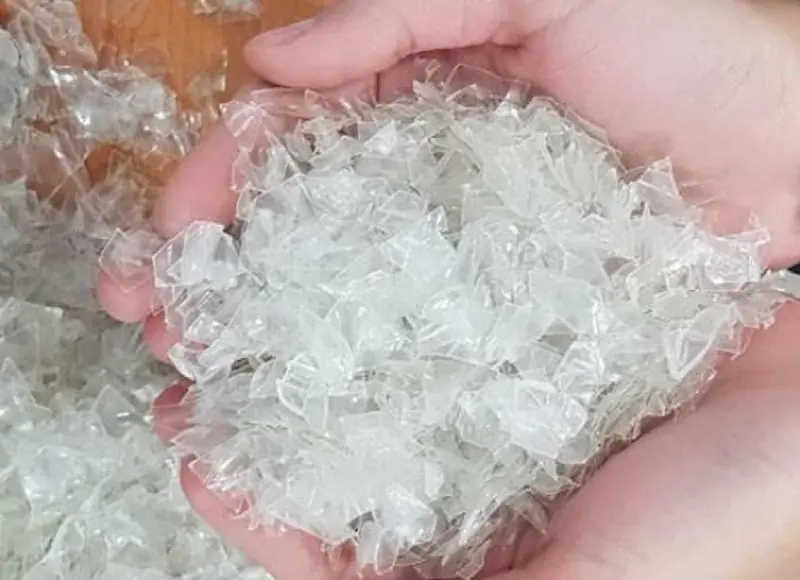
Before crushing, a shrink sleeve or paper label is a large, recognizable object. After the plastic crusher, the same label may be broken into dozens or hundreds of small fragments mixed throughout the PET flakes.
Large labels can be removed by mechanical scraping and air separation because label and bottle differ so much in shape, mass and aerodynamic behavior. Small fragments are much harder: they stick to wet flakes, travel with the process water, get trapped between flakes or pass into the drying and sorting section.
This is the main reason the delabeling stage sits before the crusher: remove contamination while it is still easy to identify and separate.
Not all PET bottle labels are the same
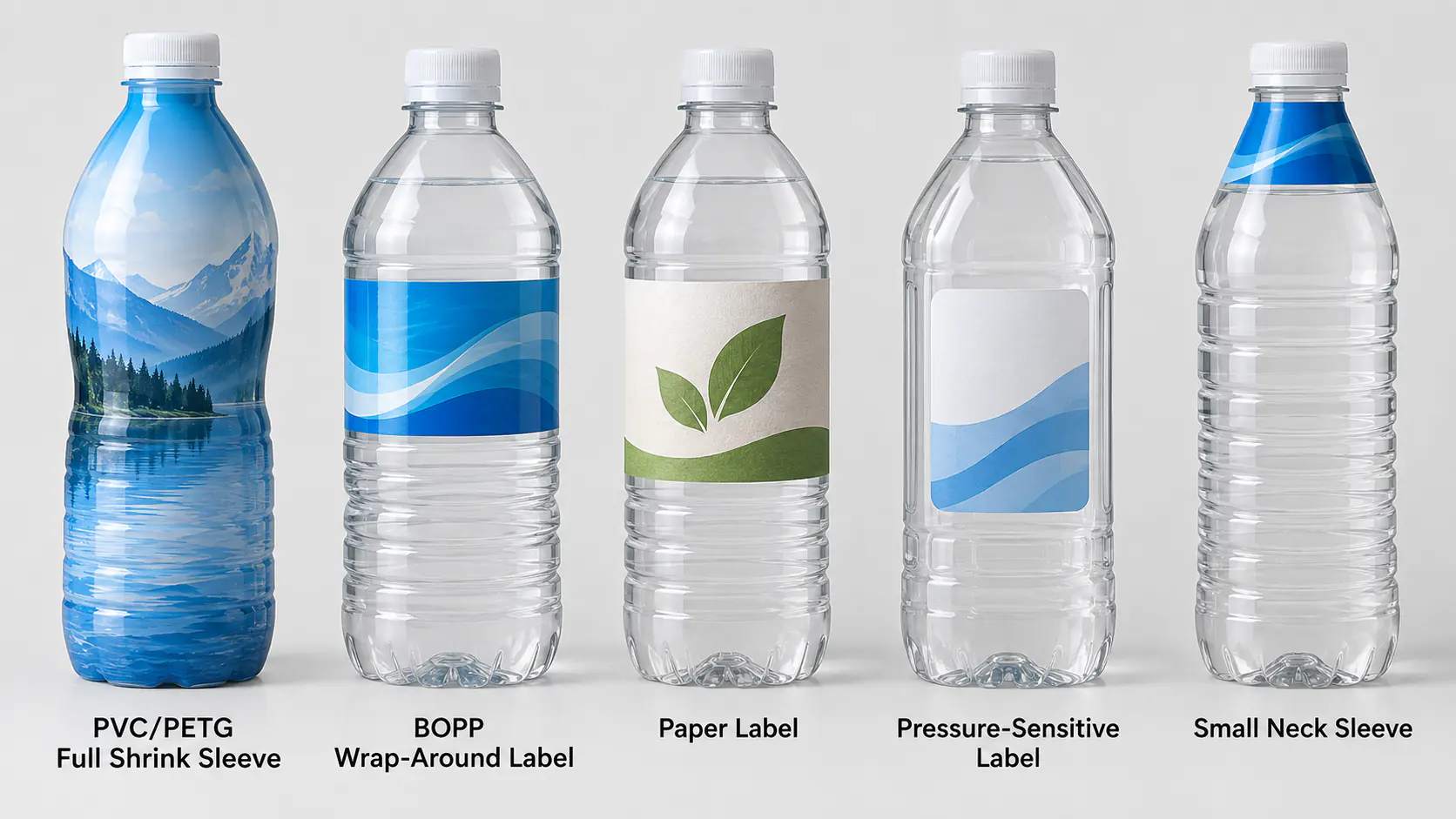
‘Label’ covers several materials and attachment methods. A line that receives mainly paper labels behaves differently from one fed with full-body PVC or PETG shrink sleeves.
| Label type | Typical material | Main removal challenge | Best control stage |
|---|---|---|---|
| Heat-shrink sleeve | PVC, PETG, OPS or other film | Wraps the bottle tightly; may cover most of the surface | Mechanical label remover before crushing + bottle/flake sorting |
| Wrap-around film label | BOPP / PP / PE | Detaches easily but creates light film fragments | Delabeling + air separation + float-sink |
| Paper label | Paper with adhesive | Breaks into fibers; glue may stay on the PET | Pre-wash / delabeling + hot wash for residual adhesive |
| Pressure-sensitive label | Film or paper + adhesive | Label may come off but adhesive stays on the bottle | Mechanical removal + hot washing |
| Partial sleeve / neck label | Various films | Small pieces escape mechanical removal | Bottle delabeling + downstream label separator |
PVC and PETG shrink sleeves need special attention
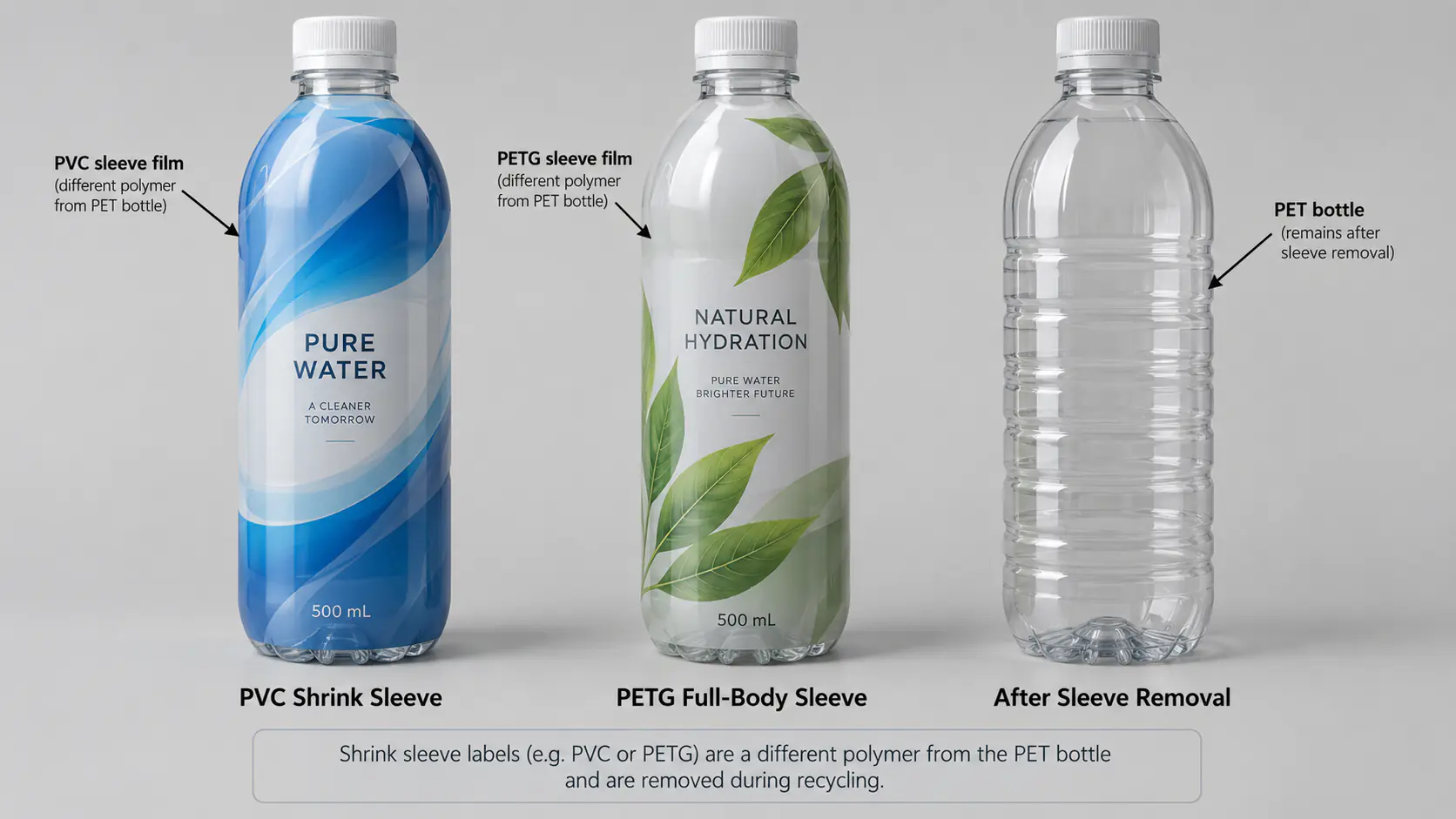
Heat-shrink sleeves matter most because many are made from polymers other than PET. PVC is especially harmful: even small amounts degrade at PET processing temperatures and cause discoloration, black specks and acidic by-products that also attack IV in pelletizing.
PETG sleeves are a different problem. Their density and appearance are close to PET, so once both are crushed into small flakes, simple density separation cannot reliably remove them.
A full-body sleeve also hides the bottle from optical bottle sorters, which may not identify the polymer under a large opaque or printed sleeve. Removing the sleeve early improves both mechanical cleaning and later sorting accuracy.
PVC and PETG sleeves sink with PET in a float-sink tank. They have to be removed while they are still sleeves, or caught by bottle and flake sorting.
How a PET bottle label remover machine works
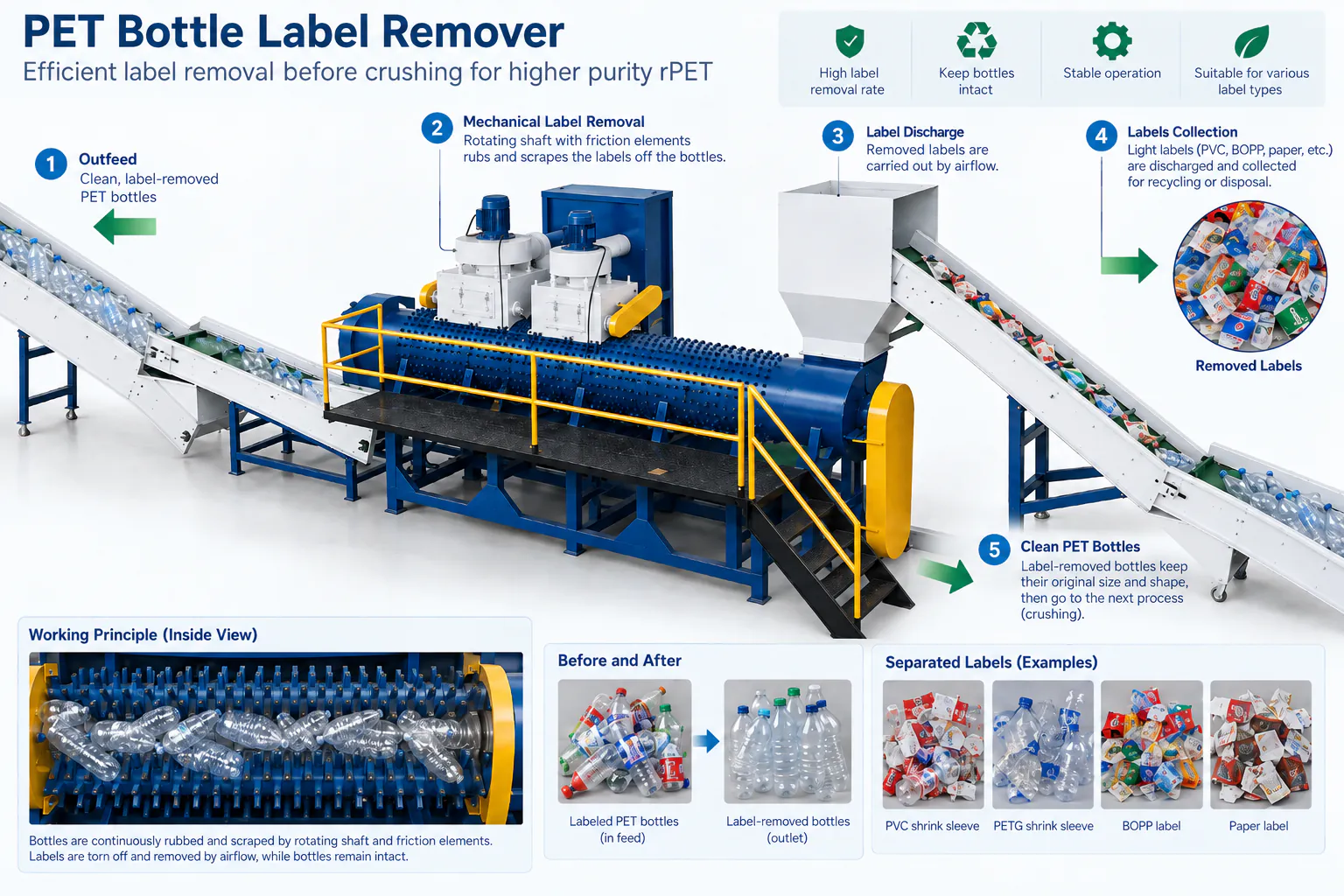
The machine is sold under several names — label remover, delabeler, label removing machine or bottle label remover machine. They describe the same front-end unit for whole bottles.
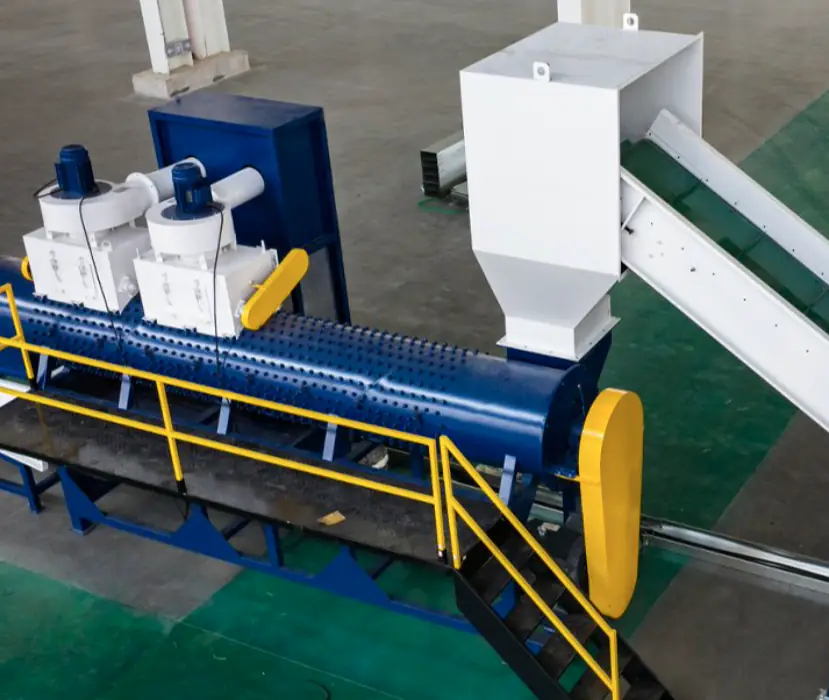
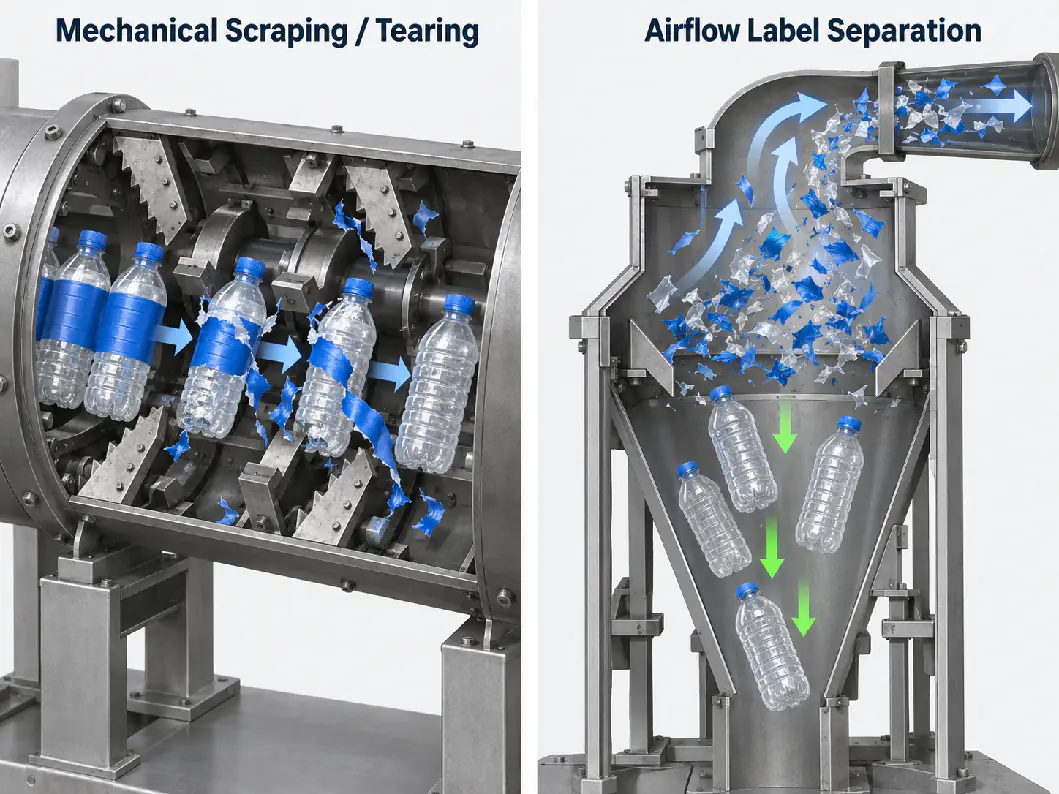
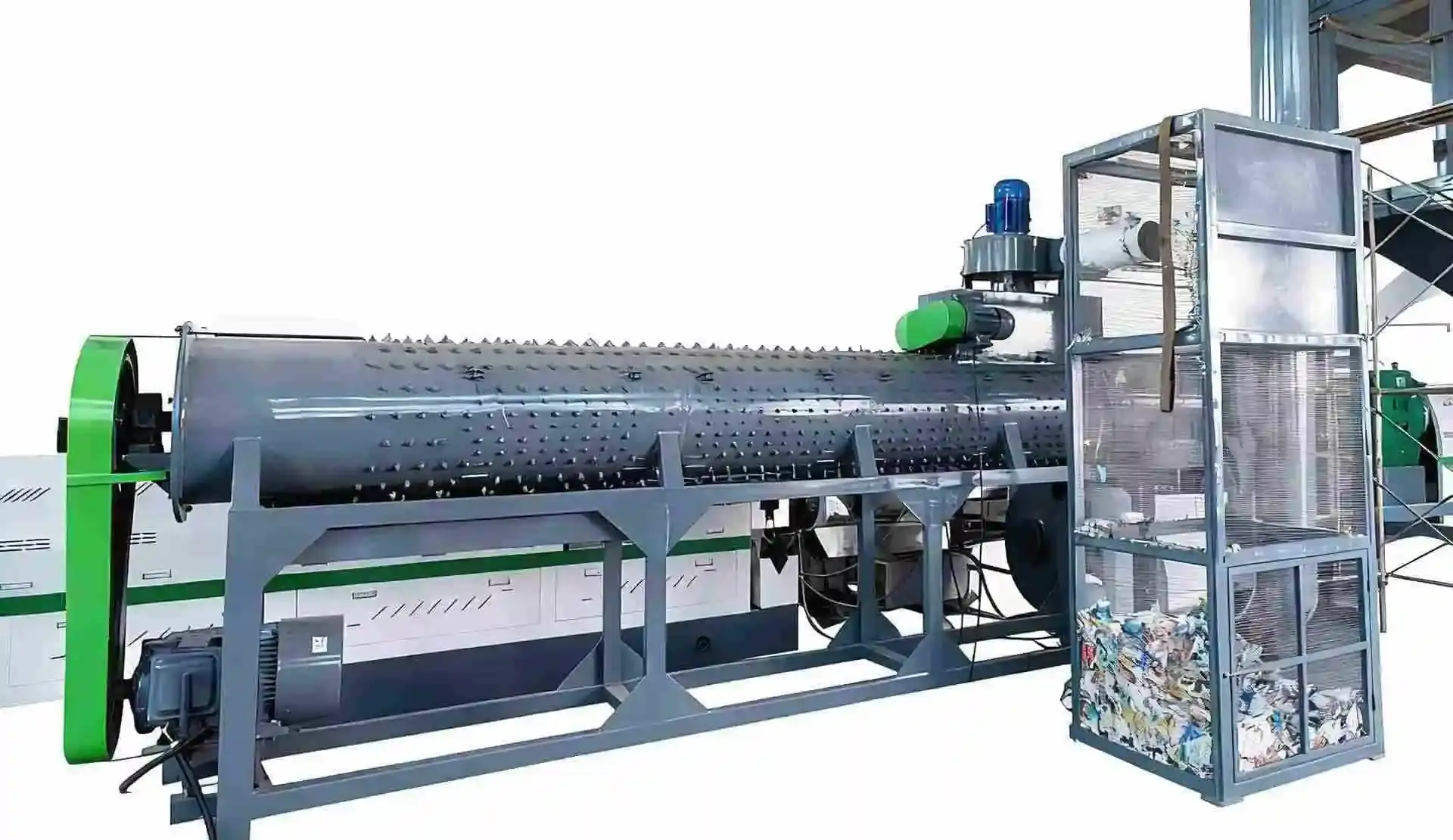
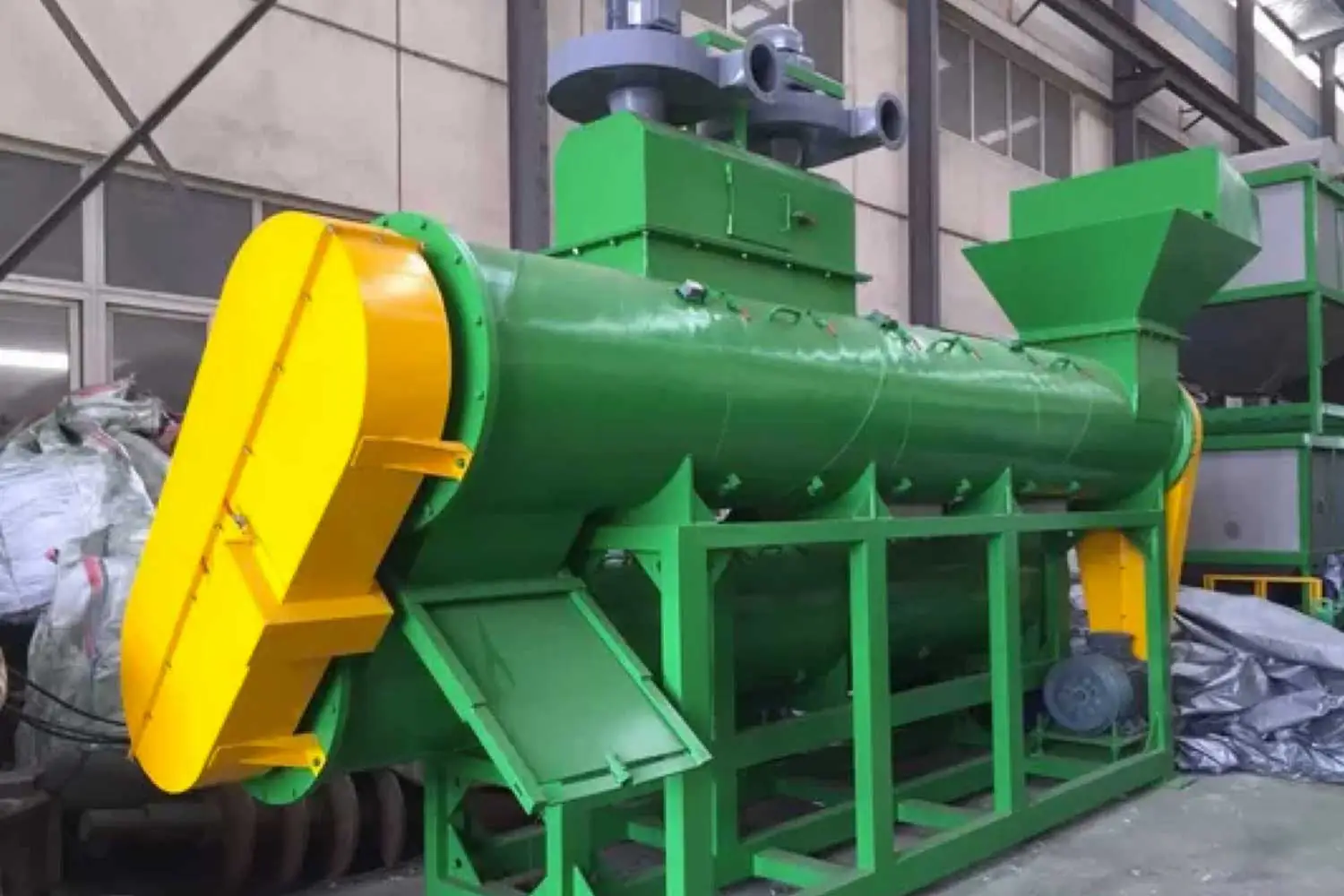
A typical unit has a long chamber with a rotating shaft or drum carrying scraping elements, blades, bolts or teeth, and fixed scraping elements around the chamber wall. As bottles move along, repeated contact tears and loosens the label from the bottle surface.
The aim is not to crush the bottle. A good delabeler opens or tears the label while keeping most bottles substantially intact. Once the label is detached, a suction fan or air-separation section draws off the light label material while the heavier bottles continue to the next process.
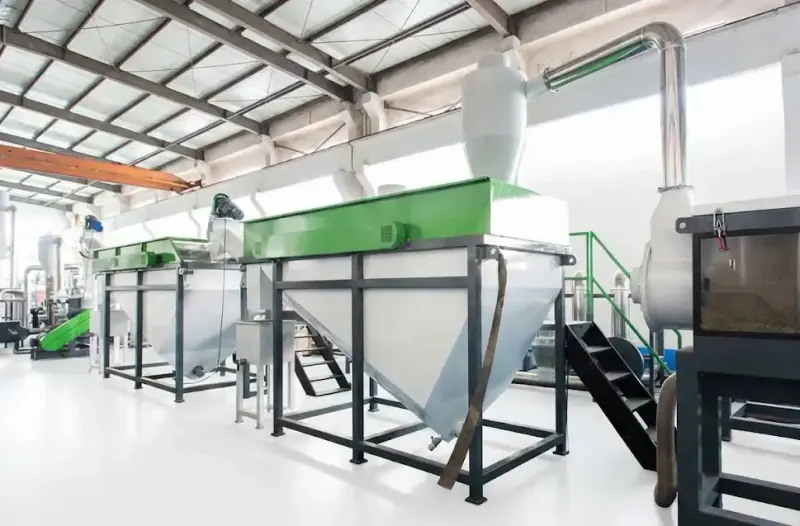
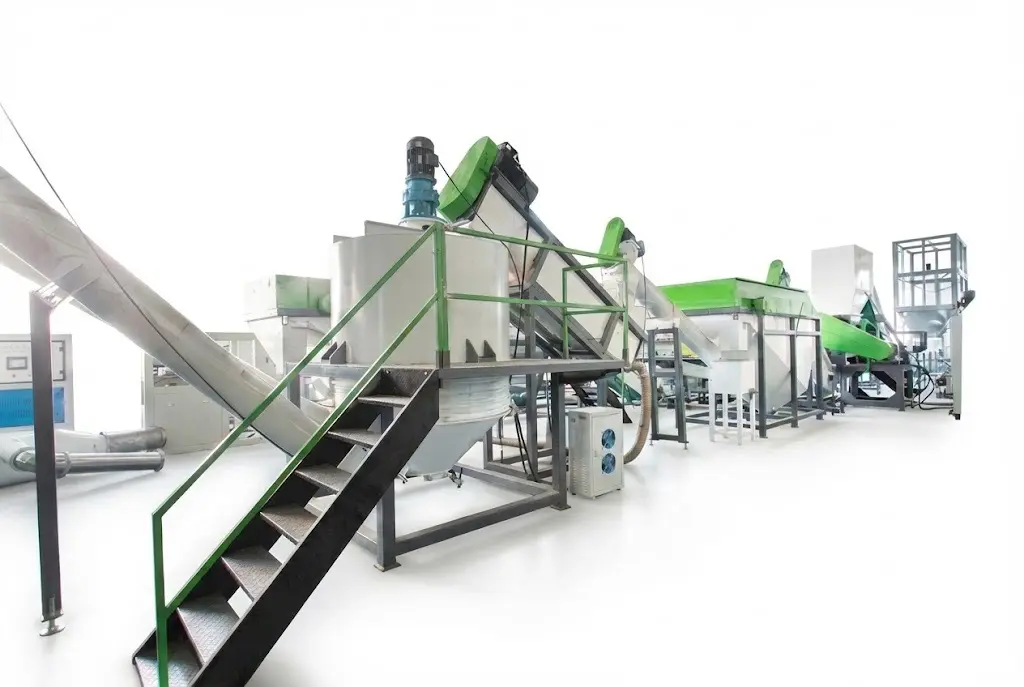
This works because a label has a far larger surface-area-to-weight ratio than a bottle, so controlled airflow can lift and carry it away. In our PET bottle washing line the label remover follows bale opening and the trommel and feeds the wet crusher.
Scraping and blowing are two different functions
Evaluate a label remover as two connected systems: the mechanical scraping section and the air-separation section.
If scraping is weak, labels stay on the bottles and no airflow can separate them. If scraping works but the airflow is poorly adjusted, detached labels stay mixed with the bottles and go on into the crusher.
Airflow that is too strong can carry light or damaged bottles into the label stream, which is direct PET loss. The fan and air channel therefore need adjusting to bottle size, wall thickness and label type.
What label removal rate should you expect?
No label remover should be judged by a single advertised efficiency figure. Performance depends heavily on bottle condition and label type.
Well-designed industrial machines can remove more than 90% of suitable labels under appropriate conditions. The result changes with compressed bottles, full-body sleeves, adhesive labels, deformed bottles and the share of bottles that enter nested together.
The most useful test is therefore a trial with the customer’s own bale material, measuring not only label removal but also bottle breakage and PET loss:
| Performance indicator | Why it matters | What to observe during the test |
|---|---|---|
| Label separation rate | Shows how much label is removed before crushing | Count or weigh labeled vs delabeled bottles |
| Bottle breakage rate | Breakage creates PET fragments before the crusher | Broken bottles and PET pieces in the machine discharge |
| PET carryover in label waste | Direct material loss | PET bottles or fragments in the label bags or ducts |
| Residual label type | Shows which labels the machine struggles with | Sort the leftovers into shrink sleeve, paper, pressure-sensitive and neck labels |
| Throughput stability | High efficiency is useless if capacity collapses | Machine load and performance under continuous feed |
Why compressed PET bales are harder to delabel
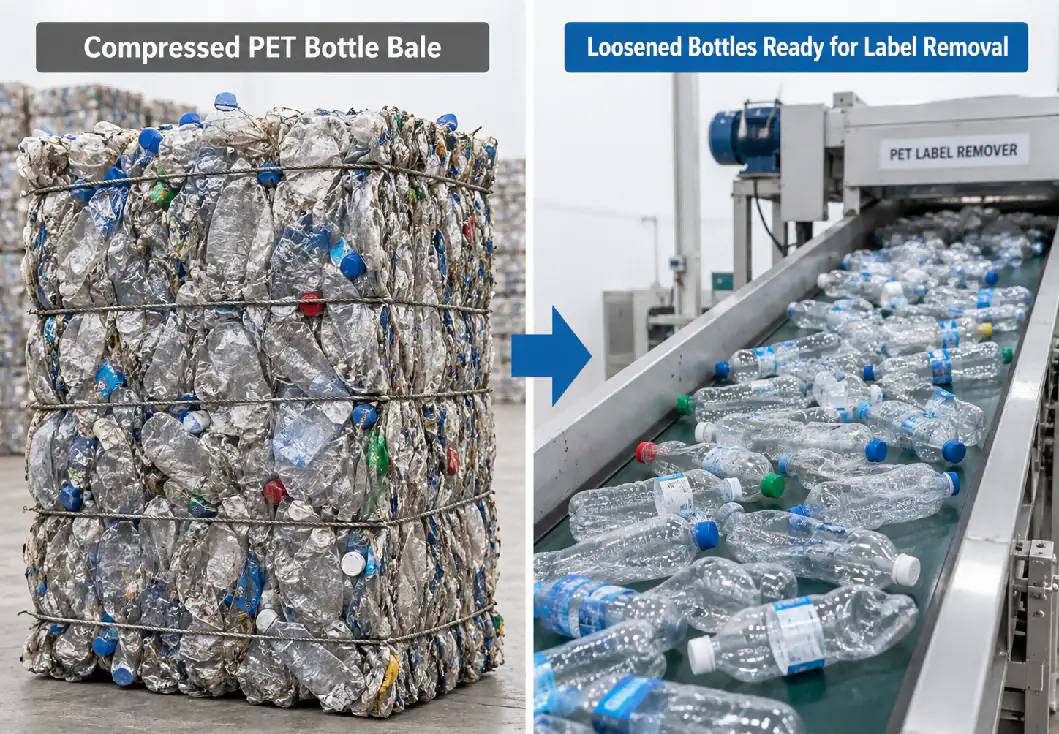
Baled bottles are often flattened, twisted or nested inside one another, so the scraping elements cannot reach every bottle surface evenly.
A sleeve can also be trapped between two compressed bottles. If the bale opener does not separate them well, several bottles travel through the label remover as one bundle.
For heavily compacted bales, good bale opening and metered feeding are essential. The label remover should receive a loose, controlled stream of bottles rather than large compressed clumps.
A label remover should not become a bottle crusher
More aggressive scraping removes more labels, but only up to a point. If rotor speed, blade projection or residence time is too aggressive, the machine breaks too many bottles.
Broken bottles create PET chips inside the delabeler. These chips are sucked into the label waste, increasing PET loss, or build up in the machine and increase wear.
The right setting balances three goals: high label separation, low bottle breakage and low PET loss.
Removing labels before wet crushing reduces the downstream load
If labels are still on the bottles when they reach the wet crusher, the crusher turns large labels into small contamination.
Those fragments then pass through the float-sink tank, friction washer, hot washer and water-circulation system. More labels mean more floating material, more paper fiber, higher solids in the water and more frequent cleaning of screens and filters.
Delabeling before crushing reduces the non-PET material the washing section must handle, improving separation without adding chemicals or water — and it is one of the main levers on the label and PVC limits in a PET flake quality specification.
Label removal improves float-sink separation but does not replace it
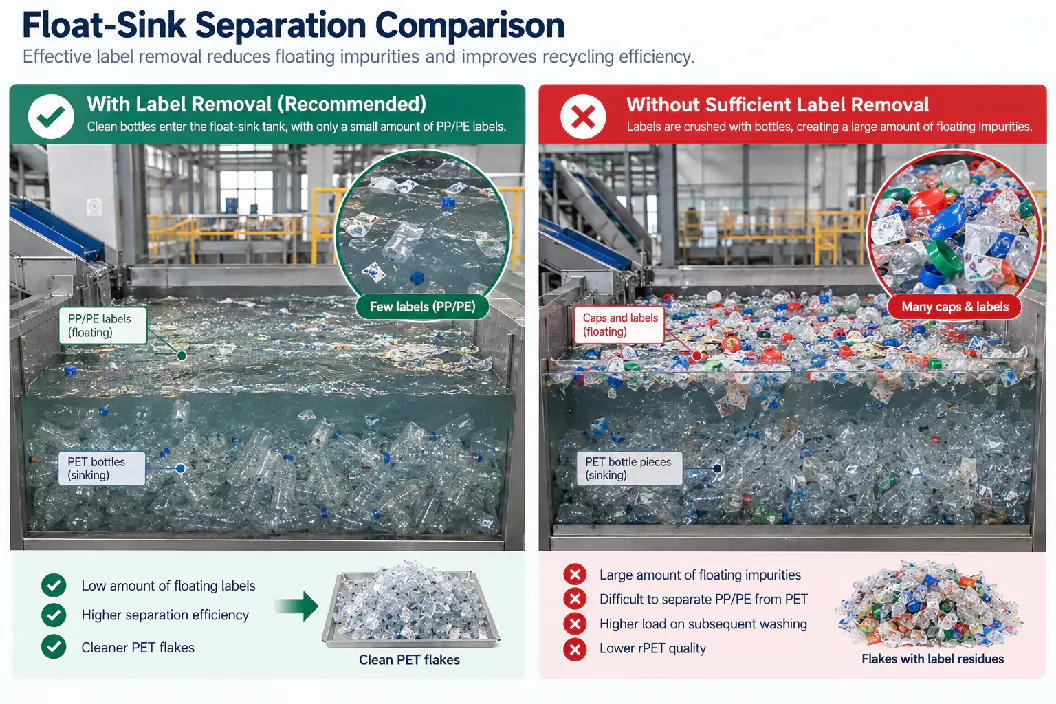
Many labels and caps are PP or PE, which float while PET flakes sink, so a float-sink tank separates them after crushing.
That does not make the label remover optional. A float-sink tank works much better when most large labels are already gone. A heavy label load creates a thick floating layer, increases mechanical carryover and can trap PET flakes in the float fraction.
Label polymers such as PVC and PETG cannot be reliably removed by normal float-sink separation at all, which makes early delabeling and bottle sorting even more important for them.
Label removal does not remove glue
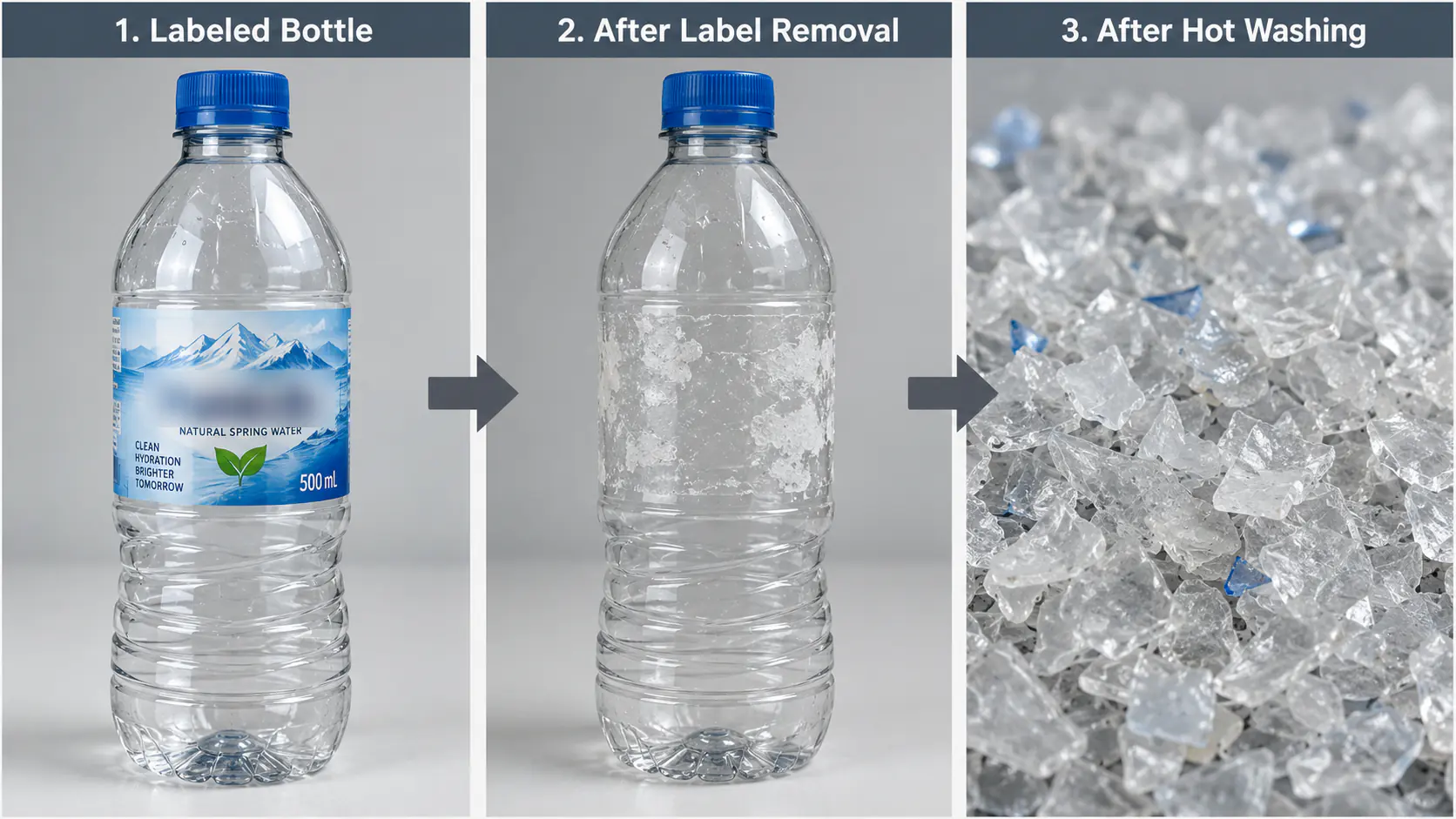
A common misunderstanding is that a delabeled bottle is free of adhesive. Mechanical delabeling removes the label material; glue can remain on the PET surface.
Pressure-sensitive adhesives and some hot-melt glues need hot washing with detergent or caustic to loosen them, followed by strong friction washing and rinsing to remove the residue.
For high-quality PET flakes, mechanical delabeling and hot washing solve different problems. One does not replace the other.
Where should the label remover go in a PET recycling line?
In most post-consumer PET bottle lines, the label remover comes after bale opening and early removal of large contaminants, and before the crusher. A typical front-end sequence is:
- Bale opening
- Trommel: loose dirt and small contaminants
- Metal separation
- Bottle sorting
- Mechanical label removal
- Pre-washing where required
- Final bottle inspection / sorting
- Wet crushing
The exact order varies with bottle condition. Some projects pre-wash to loosen dirt or adhesive labels, while heat-shrink sleeves should generally be removed mechanically before any hot process that could shrink them tighter. For the complete process, see how a PET bottle washing line works.
Zig-zag label separator after washing and drying
No front-end label remover catches every fragment. Small neck sleeves, pieces trapped in bottle folds and residual light films can survive.
That is why many high-quality PET washing lines add a downstream zig-zag separator — also called a zig-zag air classifier or label separator — after washing and drying. Controlled airflow through a zig-zag channel lifts light, dry label fragments and fines out of the heavier PET flakes.
The two machines do different jobs. The front label remover keeps large labels out of the crusher; the final zig-zag separator polishes flake quality by removing the light fragments that survived washing. Both appear in a complete PET bottle recycling machine line.
Label type determines the best machine setting
Full-body sleeves, loose wrap-around films and paper labels do not respond the same way to one scraping intensity and airflow.
Full sleeves need enough tearing action to open the film. Thin BOPP labels need an air separator that captures light pieces efficiently. With paper labels, moisture and adhesive condition affect how easily the paper comes off.
A machine that performs well on one bottle stream may need blade, speed or airflow adjustment on another. That is why a production trial with real feedstock tells you more than comparing motor power.
What affects label removal efficiency?
- Bottle shape and diameter.
- Bottle wall thickness and rigidity.
- Round, square or heavily deformed bottles.
- Degree of bale compression.
- Label material: PVC, PETG, PP, PE, BOPP, paper or other film.
- Full-body sleeve versus partial label.
- Label thickness and shrink tightness.
- Type and amount of adhesive.
- Rotor speed and scraping-element design.
- Residence time in the machine.
- Bottle feed rate and how stable the flow is.
- Air-separation volume and air-channel adjustment.
Conclusion: remove labels while they are still labels
The best time to remove a bottle label is before the crusher turns it into hundreds of small contaminants.
A properly selected label remover reduces the PVC/PETG sleeves, PP/PE film, paper and other label material entering the washing section. That lowers the separation load, reduces label fragments in the process water and improves conditions for hot washing and final flake sorting.
It does not replace bottle sorting, float-sink separation, hot washing or a downstream zig-zag separator. It is the first major contamination-control step in a high-quality PET bottle recycling line.
When you evaluate a label remover, look at real-bottle performance: label separation rate, bottle breakage, PET loss, stable throughput, wear-part life and which labels remain after treatment. That tells you much more than motor power — and you can send us your bales for a trial.
Frequently asked questions
What does a PET bottle label remover do?
It strips shrink sleeves and labels from whole PET bottles before crushing. A rotor with scraping elements tears the labels off without crushing the bottles, and an air-separation stage blows the light labels away from the heavier bottles.
What label removal rate can a label remover reach?
Well-designed machines can remove more than 90% of suitable labels under appropriate conditions. Compressed bales, full-body sleeves, adhesive labels and deformed or nested bottles lower the result, so test with your own bales and measure bottle breakage and PET loss as well.
Where is the label remover installed in a PET washing line?
After bale opening and early removal of loose dirt and metals, and before the wet crusher. Shrink sleeves should be removed before any hot process that could tighten them.
Does a label remover remove glue?
No. It removes the label material; adhesive can stay on the PET. Hot washing with detergent or caustic, followed by friction washing and rinsing, removes the glue.
Do I still need a float-sink tank if I have a label remover?
Yes. The float-sink tank separates PP/PE caps and labels after crushing and works better when most labels are already removed. PVC and PETG sleeves sink with PET, so they must be removed earlier.
What is the difference between a label remover and a zig-zag label separator?
The label remover works on whole bottles before the crusher and removes large labels. A zig-zag separator works on dry flakes after washing and uses airflow to remove the light label fragments and fines that survived washing.
Label remover trial
Want to know how your bottles will delabel?
Send photos of your bales and labels. Our engineers will recommend the bale opening, label remover and separator setup, and can run a trial with your bottles to measure removal rate, breakage and PET loss.
Request a trial- Bale photos and compression
- Label types: sleeve, BOPP, paper
- Target capacity in kg/h
- Required flake quality